
Two tiers, 22,900 homes on paper: Malé's new housing rules
What changed, who qualifies, and what's still missing.

Artwork: Dosain
30 Dec 2025, 17:59
On Monday, the government published new policies for awarding flats and plots of land in the Greater Malé Region. Here's what changed and what the fine print says.
What are the new rules for?
More than two years after taking office, the government is preparing to allocate 15,000 plots and 7,900 flats in the Greater Malé area – construction of which has yet to commence – under its "Housing for All" scheme. Applications open January 15 with a deadline of April 14.
The separate policies for awarding flats and land plots replaces rules gazetted on November 17 to determine who qualifies and how they will be selected.
What changed from November?
The housing ministry says the policies were amended in light of concerns raised by the public at community meetings recently concluded by President Dr Mohamed Muizzu in each ward of Malé.
Three main changes were made to the eligibility criteria. First, recipients of one or two-bedroom apartments under previous schemes can now surrender them and apply for larger units if they have children under 18 (for one-bedroom holders) or children of both genders under 18 (for two-bedroom holders).
Second, applicants whose spouse owns property on another island will no longer disqualified. Only a flat or home that exceeds 400 square feet in the Greater Malé area will count against husbands or wives. The previous rules applied to any property owned by a spouse anywhere in the country.
Third, the requirement to belong to a "permanent address" in Malé was revised to allow application one year after registration. The period was slashed from five years in November to one year. The previous administration's rules barred persons who were ever registered on any other island.
Who can apply?
The scheme divides applicants into two categories based on registration status.
Malé-registered residents – those listed in a house registry or the special dhaftaru (municipal registry) for at least one year – can apply for plots and flats from Hulhumalé, Gulhifalhu, and Giraavaru as well as Rasmalé, the Muizzu administration's flagship "eco-city" project to develop an urban centre on the reclaimed Fushidhiggaru lagoon in South Malé atoll.
Residents from other islands who have lived in Malé continuously for 15 years can apply for plots and flats only from Rasmalé.
Basic requirements include being 18 or older, not owning more than 400 square feet of land or property anywhere, and not having received housing under a previous government scheme.
Why is there so much tension around housing policy?
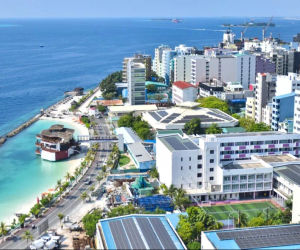
Housing in the densely-packed, 2.2-square kilometre island of Malé is the most divisive fault line in Maldivian society, pitting native residents against 100,000 migrants from other islands who have spent decades paying rent in the capital.
In its bid to resolve the crisis, the previous Maldivian Democratic Party government created two parallel schemes: Binveriya gave free land plots exclusively to native residents, while Gedhoruveriya offered flats to long-term residents. The outrage and debate sparked by the two-tier structure – based on a permanent address often determined at birth by your parents' choices – continues to rage on social media. Critics call the exclusive Binveriya scheme discriminatory, arguing that it rewards an accident of birth with prime real estate worth MVR 12 million (US$ 778,200) while forcing migrants to pay for smaller flats over decades.
Defenders counter that native Malé residents need "breathing space" after generations of subdividing inherited land into ever-smaller plots. Many point out that other islands also distribute free land to registered residents, effectively excluding outsiders through point systems.
The current administration has also backed the practice of bestowing plot of land for free.
Under the MDP government, 20,697 people applied for the 4,000 Gedhoruveriya flats whilst 15,164 people applied for the Binveriya plots by October 2022, underscoring the largely unchanged high demand from the 25,000 applications for the 7,000-flat Hiya social housing project in 2018.
More than half the population (361,576 people) is projected to live in Malé by 2062 – "while depopulation occurs in atolls" – up from 42 percent in 2022 (227,613 people).
What does uninterrupted residency mean?
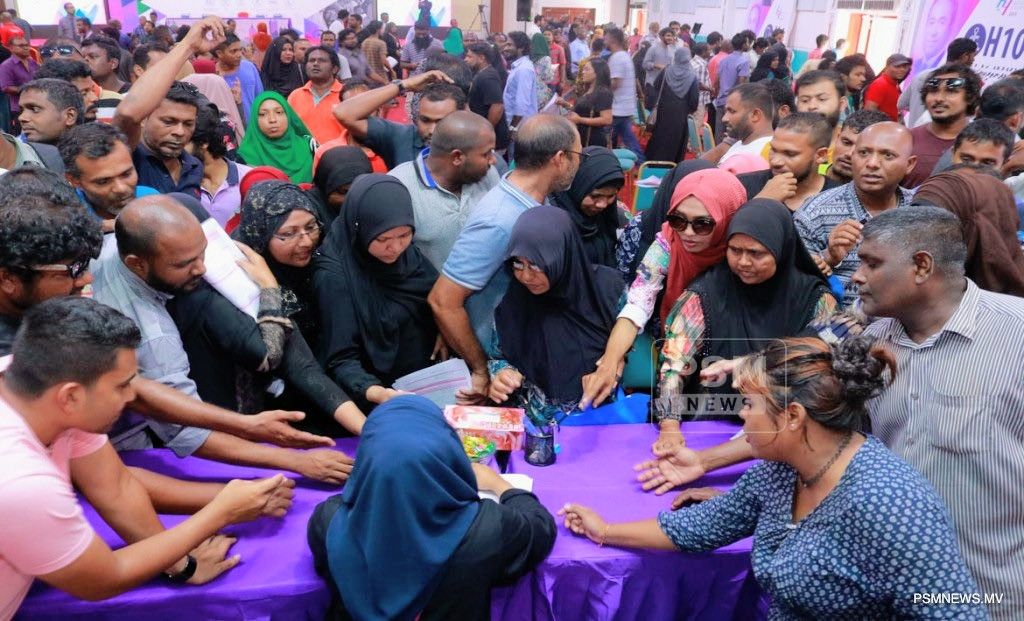
The new rules clarify that gaps do not count if applicants had left Malé temporarily for work assignments, education, medical treatment, or other essential reasons. But an applicant's family must have remained in Malé or they must have maintained ties such as children's schooling. If total gaps are shorter than the total time in Malé, and an applicant has accumulated 15 years overall, they will qualify.
How are the flats distributed?
Two ways: a "rent-to-own" model for households earning under MVR 60,000 monthly can pay rent the full price is covered, and then gain outright ownership of the apartment. The other "affordable home ownership" model is for higher earners who qualify for bank financing at subsidised rates.
On Monday, the Bank of Maldives contracted two Chinese companies to build more than 2,400 "affordable housing units" in Hulhumalé.
Can applicants choose how many bedrooms they want?
No, but they can state a preference. The housing ministry will decide what they get based on an assessment of living conditions.
Why is MVR 60,000 the income ceiling?
That’s unclear. About US$3,900 a month is a high income by Maldivian standards. It’s enough to qualify for commercial mortgages. A 2022 World Bank report on housing in the Maldives recommended much tighter targeting: council housing for those earning under MVR 15,000, affordable housing for MVR 15,000 to 25,000, and mid-range options for MVR 25,000 to 45,000.
Is this actually "social housing"?
Not in the way the term is used internationally. True social housing, also called council housing, refers to permanently subsidised rental units that remain in public ownership.
What the Maldives calls "social housing" is really a subsidised purchase scheme. Under rent-to-own models, tenants buy the flat over 20 to 25 years. Once it’s paid it off, they are free to sell at market rates.
The World Bank specifically recommended creating "permanent affordable rental stock with voucher/subsidy programs" alongside the rent-to-own model.
But at present, there is no council housing tier, no rental vouchers, and no sliding-scale subsidies based on income.
How much will the flats cost?
The government hasn't announced prices for this scheme yet. For reference, the Hiya flats in Hulhumalé Phase 2 were priced at MVR 7,500 monthly over 25 years, totalling about MVR 2.25 million (US$146,000). The World Bank calculated that the government subsidy per Hiya unit was MVR 489,000, nearly 40 percent of construction cost.
How did that go?
Not well. The 2022 World Bank report found a 37 percent default rate across existing rent-to-own projects. The state-owned Housing Development Corporation was unable to enforce evictions or even report delinquencies to the credit bureau. Revenues from the schemes weren't covering debt service costs, requiring repeated government bailouts.
According to figures made public in July this year, HDC was owed MVR 628 million from Hiya flat tenants, 70 percent of which was unpaid rent. Of 8,511 social housing flats under HDC’s management in Hulhumalé, rent was regularly paid for only 3,219 flats.
Asked about HDC's decision to waive fines incurred for non-payment, Housing Minister Dr Abdulla Muththalib told the press on Sunday that the government was seeking to incentivise regular rent payments and enable tenants to clear their debt.
Who gets priority under the new schemes?
Eleven categories of people, including single parents with children under 18, families with disabled members, newlyweds, judiciary families, taxi drivers, tourism workers, fishermen, and people promised flats under previous schemes (Veshi Fahi Malé, Hiyaa) who never got them.
Is there any income verification?
The rules require employment details, salary information, business income, and 12 months of bank statements. But there's no indication of means-testing or progressive subsidies.
What about sub-letting?
The World Bank flagged sub-letting as some beneficiaries reportedly rented out their subsidised flats at commercial rates, in some cases up to ten times what they pay. Addressing the issue on Sunday, Dr Muththalib noted that sale purchase agreements such as those for the Hiya flats do not explicitly prohibit sub-letting. "It says you can't do anything illegal. So now we need to change the law to state that renting out is illegal. That effort is ongoing," he told reporters, referring to a housing bill currently before parliament, which he said would make sub-letting social housing an offence. At present, the agreements and existing laws pose difficulties with eviction, he added.
As "a first step," the government is seeking to vacate units illegally leased for kitchens or expatriate labour quarters, the minister said.
How much is all this costing the government?
HDC carries MVR 7.2 billion in government-guaranteed debt, the bulk of which stems from the Hiya project that the World Bank estimated cost MVR 10.5 billion, or roughly MVR 1.6 million per unit.
What did the World Bank recommend?
A fundamental redesign: income-based eligibility with annual verification, progressive subsidies (more help for lower incomes), screening for capacity to pay, permanent rental housing for those who can't afford to buy, better property management, stronger enforcement against sub-letting, and clearer institutional roles.
The report argued that spending more money wouldn't solve the problem without structural reforms and recommended shifting from "government as builder" to "government as enabler" through targeted subsidies and private sector partnerships with proper safeguards.
What does the opposition say?
At a press briefing on Monday, MP Mauroof Zakir noted President Muizzu's declaration of 2025 as the "special year of housing" and pointed out that the year is ending without a single project. "What couldn't be done in the special housing year won't be done in the remaining three years either," he said.
The MDP has also alleged that the Rasmalé reclamation contract is inflated by US$ 200 million. More broadly, the opposition argues the new rules are window dressing ahead of April's local council elections. Lists will be drawn up, but without land reclamation complete or construction underway, the flats and plots exist only on paper.
A breakdown of the plots and flats:
PLOTS (15,000 total)
Size: 1,250 square feet each
CATEGORY 1: MALÉ RESIDENTS (10,000 plots)
Location: Greater Malé and Rasmalé
Born and registered in Malé house registry: 7,000
Registered in Malé dhaftaru: 1,000
Later registered in Malé house registry: 2,000
CATEGORY 2: NON-MALÉ RESIDENTS LIVING IN MALÉ (3,000 plots)
Location: Rasmalé only
SPECIAL PRIORITY CATEGORIES (2,000 plots)
Persons deprived due to incapacity (mai mulhavun): 500 (Must be legally incapacitated)
Owners of undevelopable plots in narrow alleys: 1,500 (either: (a) plot on alley narrower than eight feet with all co-owners agreeing to relinquish to government, OR (b) co-owned plot where each share is under 200 square feet with all co-owners agreeing to surrender)
FLATS (7,900 total)
CATEGORY 1: MALÉ RESIDENTS (4,000 flats)
Registered in Malé house registry: 2,200
Registered in Vilimalé house registry: 300
Registered in Malé dhaftaru: 1,000
Later registered in Malé house registry: 500
CATEGORY 2: NON-MALÉ RESIDENTS LIVING IN MALÉ (1,500 flats)
SPECIAL PRIORITY CATEGORIES (2,400 flats)
Single parents with children under 18: 100 (registered with NSPA for 1+ year)
Persons with disabilities: 100 (on National Disability Registry)
Youth under 35 (or one spouse under 35): 250
Taxi drivers: 50 (on national registry, 5+ years driving, not employed full-time elsewhere, commit to five more years)
Tourism workers: 200 (5+ years at resort, commit to five more years)
Judiciary staff: 100 (5+ years service, commit to five more years)
Fishermen: 100 (on national registry, 5+ years fishing, commit to five more years)
Persons deprived due to incapacity: 50 (legally incapacitated)
Veshi Fahi Malé / Hiya letter holders: 500 (received promise letter but never got flat)
Destitute families (assessed): 50 (ministry-designated agency assessment)
Police: 100 (5+ years service, commit to five more years)
MNDF: 100 (5+ years service, commit to five more years)
Civil servants: 200 (5+ years service, commit to five more years)
Corrections officers: 100 (5+ years service, commit to five more years)
Staff of specified institutions: 400 (5+ years at institution, commit to five more years)
The 22 specified institutions for the final category:
1. President's Office
2. Parliament
3. Attorney General's Office
4. Foreign Service
5. Judicial Service Commission
6. Elections Commission
7. Civil Service Commission
8. Human Rights Commission
9. Anti-Corruption Commission
10. Auditor General's Office
11. Prosecutor General's Office
12. Maldives Monetary Authority
13. MIRA
14. Pension Office
15. National Integrity Commission
16. Broadcasting Commission
17. Family Protection Authority
18. National Disaster Management Authority
19. Children's Ombudsman
20. Employment Tribunal
21. Local Government Authority
22. Tax Appeal Tribunal
Discussion
No comments yet. Be the first to share your thoughts!
No comments yet. Be the first to join the conversation!
Join the Conversation
Sign in to share your thoughts under an alias and take part in the discussion. Independent journalism thrives on open, respectful debate — your voice matters.
Support Independent Journalism
Help us keep the news free and fearless
Give once
$
or
Become a memberfrom $5/month