
"We simply have to keep going": Maldives' first Magsaysay laureate on fighting an existential timeline
Shaahina Ali on three decades of defending Maldivian reefs.
Artwork: Dosain
26 Jan, 14:10
In the early 1990s, Shaahina Ali opened the first dive school in Malé and descended into the waters off the capital's west side. What she found was a reef choked with bicycles, tires, and curtains of fishing line – corals somehow still fighting to survive beneath the debris.
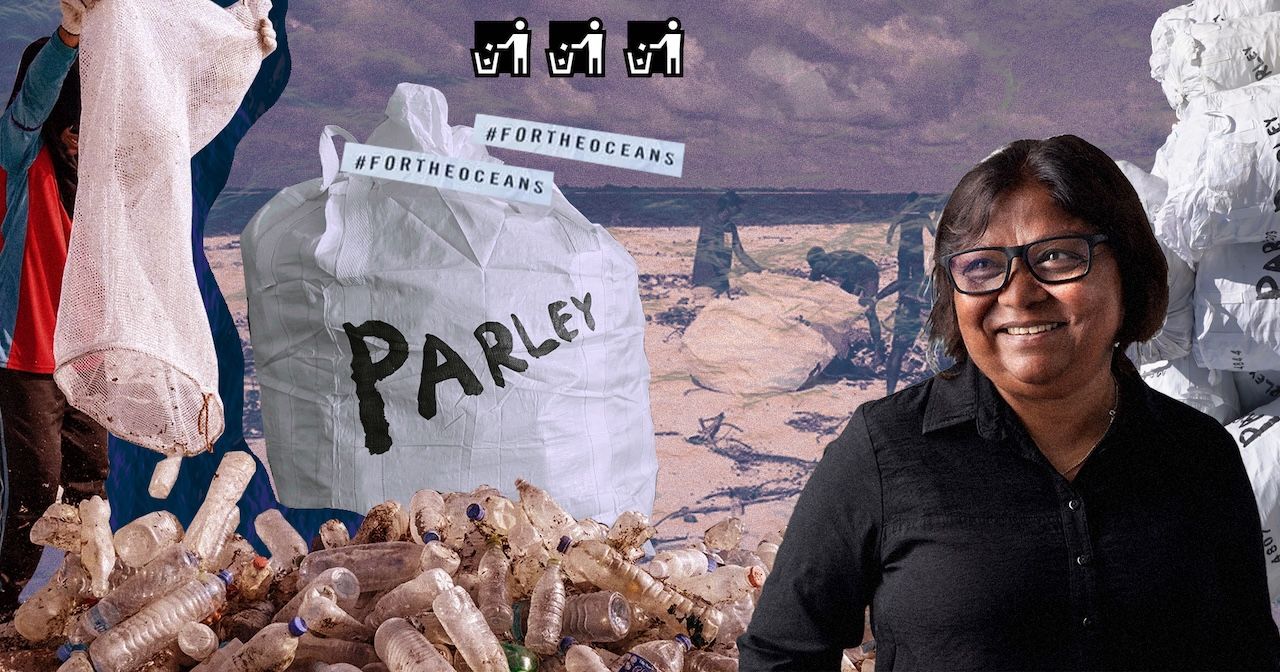
Three decades later, Shaahina became the first Maldivian recipient of the Ramon Magsaysay Award, often called Asia's Nobel Prize. As Executive Director of Parley Maldives, she has spent a decade leading a nationwide movement against plastic pollution, establishing waste interception points in over 70 schools and organising more than 700 coastal cleanups.
We spoke with Shaahina about that pivotal moment beneath Malé's waters, what the award means for environmental advocacy in the Maldives, and how she maintains hope while confronting an existential timeline.
The Ramon Magsaysay Award citation describes how you came "literally face to face with tides of trash" while diving in our once-pristine waters. Can you take us back to a specific moment when you realised the scale of the plastic crisis facing the Maldives – and when did confronting it become your life's work?
Trash anywhere bothers me. When I started diving in the early 80s it was very different – there was not much permanent waste – and I did not dive on the Malé house reef. Even today if we dive on a reef away from an inhabited island there is not a shocking amount of trash.
For me the moment was in the early 1990s when I opened the Sea Explorers dive school in Malé and then diving on the Malé house reef. The whole reef on the west side, at the end of Majeedhee Magu, was full of waste – old bicycles, tires, and all sorts of waste and the fishing lines – a whole curtain of fishing lines and in spite of this the corals trying to survive and grow.
We did the first cleanup in 1991 to show this and removed about seven pickup loads of trash. After that we did reef cleanups around Malé a lot to create awareness and give the message that waste dumping in the ocean is not away – it is still there and it is causing so much damage on our reefs. This also started our work of educating and taking school teachers and students out for snorkelling and giving them that opportunity to see, experience and wonder and for them to feel and understand the reef environment.
You've become the first Maldivian to receive the Ramon Magsaysay Award. What does this recognition mean for you personally, and more importantly, what do you hope it means for environmental advocacy in the Maldives?
I feel happy that the Maldives is finally in the list of nationalities that has received this award since it started in 1958. At the same time I feel very encouraged and hopeful to be recognised amongst the many great personalities who have received this award. It has given me the will and determination to continue the work in a time our work in environment, oceans and climate feels so hopeless.
Parley Maldives has established plastic interception points in over 70 schools and conducted more than 700 coastal cleanups since 2015. What have been the most surprising successes, and what challenges persist in changing mindsets among both Maldivians and tourists?
For me any work in reducing waste ending up in the environment is a success. Every cleanup we have done has diverted so much from directly ending in the ocean and from this we have taken tons of cleanup plastics out of the Maldives for repurpose.
Parley's success is seeing the islands that started the interception program with us still continuing to keep doing so. We strongly believe that when a solution is given to people it is easy for people to do the right thing.
The challenge is not having the bigger solution or the central waste management system not in place. The plastics we can send out for recycling is very small – the rest we have to still put in the landfill. Even today all our islands are either open burning the waste or creating landfills that will sooner or later need to be managed and most of the time it is used as reclamation material.
You've emphasised that Parley is "100 percent a local organisation" with communities as the true champions. How do you balance outside partnerships and funding with ensuring solutions are truly community-owned and sustainable?
Parley for the Oceans is a global foundation. Parley Maldives is a fully local organisation – we run the Parley for the Oceans program by implementing the Parley AIR strategy: Avoid, Intercept, Redesign.
We operate with a few staff and our communities are our strength. We just provide the backend needed and we send the recyclable plastics to recyclers and all the recycled plastics from the Maldives are repurposed by global partners.
How do you navigate conversations with resort operators about sustainability when their business model depends on providing luxury experiences that often generate significant waste?
Resorts in the Maldives are also challenged with the lack of a national waste management facility. They can only send to Thilafushi and Thilafushi is overwhelmed with the waste from Malé and the resorts and does not yet have the facilities to handle it.
Resorts themselves can manage so much and many do. There will always be the ones that do not adhere to the government's laws and regulations and that does not justify labelling all resorts.
Our conversation is mainly to segregate the recyclables – which they already do – and also they assist us with the transport of community plastics collected in our bags, and that helps the community to get it off the island and we get to collect and export it out. We do have a lot of costs for transportation, sorting, baling and export. We also get HR resources from the resorts when we are in close by communities with assistance from their marine biologists and dive teams with equipment and volunteers to get school children in snorkelling activities.
You've said "purpose is the new luxury" in positioning the Maldives for purposeful tourism. What would this look like in practice, and are you seeing genuine shifts in the industry or mostly greenwashing?
Parley believes that "purpose is the new luxury." This was said by Parley's CEO Mr Cyrill Gutsch and I feel this speaks to the hospitality industry globally and they can use this to become more sustainable, more purposeful to educate the luxury traveler on the impacts of climate and how they can help.
You've spoken about how "the first impacts of climate change are already being felt here" and invoked the Maldivian saying about swimming until you reach shore or exhaust every effort. With warnings that the Maldives could become uninhabitable by 2050, how do you maintain hope while confronting such an existential timeline?
Yes, we simply have to keep going. We can't control the climate nor the global complacency to mitigate the emissions. That can make us very hopeless and angry but what then? We have to do whatever we can for ourselves to understand what is happening and try and survive.
But what I see here as a development policy is also accelerating the impacts of what is happening with global climate events by us compromising on trying to nurture what little nature we have – like destroying the coral reefs with short-term envisioned mass development we can't afford and expansions of land reclamation in areas where we can't project the population increase to inhabit the numbers in 50 years we have.
Maintaining hope is the only thing we can do.
Beyond plastic pollution, what are the two or three most urgent environmental priorities the Maldives needs to address in the next five years – and what role can everyday Maldivians play in driving that change?
I think climate education, connection to nature and planning development.
I think every community can connect and be more involved in understanding the natural dynamics of their islands – especially the reef and the lagoons and the roles they play. This understanding can help them decide on developments needed and how it can be achieved.
Also we need to be proud of our natural environment and we need to feel for it. Unless we do this we will not care enough to fight for it.
Discussion
No comments yet. Be the first to share your thoughts!
No comments yet. Be the first to join the conversation!
Join the Conversation
Sign in to share your thoughts under an alias and take part in the discussion. Independent journalism thrives on open, respectful debate — your voice matters.
Support Independent Journalism
Help us keep the news free and fearless
Give once
$
or
Become a memberfrom $5/month