
Environment minister bypassed safeguards to approve Addu wetlands reclamation
Three-day approval ahead of presidential visit.

Artwork: Dosain
11 Nov 2025, 18:08
More than 60 percent of respondents to a public survey opposed reclaiming a protected wetland in Addu City. Environment Minister Thoriq Ibrahim ordered the Environmental Regulatory Authority to fast-track approval anyway, instructing the defanged regulator to skip physical stakeholder meetings, waive laboratory testing requirements, and issue a decision within three days – just in time for President Dr Mohamed Muizzu's visit to inaugurate the project.
The reclamation of Fishimathi Moolekede, a wetland in Hithadhoo's northeast, next to the Eedhagili Kilhi protected area, is now underway to extend the link road. It was a campaign promise made by Hithadhoo North MP Mohamed Sinan from the ruling party to address traffic bottlenecks from the Moolekede area to the north of the island, a member of the Addu City Council told the Maldives Independent.
"The project is done on the demands of a couple of households in the area. We had already made changes to address the traffic flow issues in the area," the councillor said.
MP Sinan was not responding at the time of publication after saying he would call back.
The reclamation of 2.4 hectares of land falls within the 200-metre buffer zone of the protected Eedhagili Kilhi. The wetland area is also part of the Addu biosphere reserve. Due to proximity to the protected area, the project required special approval under the dredging and reclamation regulations.

Rushed in three days
The redevelopment of the Addu City link road and road construction in Hithadhoo were among several projects launched during President Muizzu's visit to the southernmost atoll last Wednesday (November 5).
On October 28, Environment Minister Thoriq sent a note to Hassan Mohamed, the chief executive of the Environmental Regulatory Authority, instructing him to bypass normal procedures – conducting stakeholder consultations, carrying out tests and reviewing the environmental impact assessment – to green light the project.
In his instruction note, Thoriq invoked recent amendments made to the EIA regulations to streamline regulatory processes for "priority projects" designated by the cabinet's economic council.
"Accordingly, I hereby designate this project as a priority project in line with the regulation, thereby qualifying it for expedited procedural arrangement," he wrote.
Thoriq advised the ERA to seek stakeholder consultation concurrent with data collection. Physical meetings would not be mandatory and a written request would be sufficient. Moreover, it was not necessary for laboratory test results to be available at the time of the EIA submission and review, he stressed, since it "could be submitted once they are available."
Once the environmental consultant submits the EIA report, Thoriq asked the ERA to use its own staff to complete the review within two days, "where review by an external reviewer is not practical due to time constraints." If reviewers decide additional information was required to issue a decision, the matter shall be deferred to the minister, the note added.
Thoriq instructed the ERA to issue a decision statement within a day of the reviewers' report.
The decision statement granting approval for the project was issued on November 4, a day before President Muizzu's planned arrival in Hithadhoo. The ERA noted that the minister had issued a decision letter on the same day "directing" the regulator to issue an "approved" decision statement.
Reclamation work commenced a day after the president inaugurated the road project.
Drone photos taken by the Maldives Independent show that the contractor started work without setting up bund walls as a mitigation measure conditioned under the EIA decision statement.
According to the EIA report, aside from the permanent burial of 2.6 hectares of shallow lagoon habitat and seagrass patches, the project would "result in mortality via burial of fiddler crabs, mangrove crabs, snails and other invertebrates." The reclamation will also impact flora and fauna in the surrounding mangrove areas, the report noted.


Broad opposition
For the impact assessment report, CDE, the independent EIA consultant, consulted with government stakeholders and residents of Hithadhoo. State institutions such as the environment ministry, the ERA and Addu Nature Park strongly objected to the project on environmental grounds and raised policy concerns due to proximity to the protected area.
A household survey of 51 residents who live within 300 metres of the project site showed 68 percent viewed it as necessary. A separate survey conducted with online forms collected 1,000 responses, mainly from young residents of Hithadhoo, which showed strong opposition from 62 percent, citing environmental concerns, loss of mangroves, flooding risks and doubts over the project's necessity and fairness.
The request for the project had been submitted to the President's Office in a petition by 122 residents of the Moolekede neighbour on March 21, 2024. The petitioners urged the government to address challenges of traffic bottlenecks leading to the north Hithadhoo. It also cited difficulties faced by residents due to coastal issues such as foul smell from the wetland area during the northeast monsoon and the high salinity of ground water during high tide.
Shortage of land was also noted as a reason despite recent reclamation in Hithadhoo making it one of the largest islands by landmass in the country.
Youth activists confront president
Project Thimaaveshi, an Addu-based youth-led environmental group, has been raising alarm over the project in recent weeks. In late October, activists from the group group staged protests on the mangrove, canoeing out to the wetland holding flags with slogans such as "Reclaim Respect, Not Land" and "Let Addu Breathe".
When President Muizzu arrived in Addu last week, members of the group met him at the Maradhoo harbour and submitted a letter highlighting concerns regarding the project and asked the president to reconsider the project.
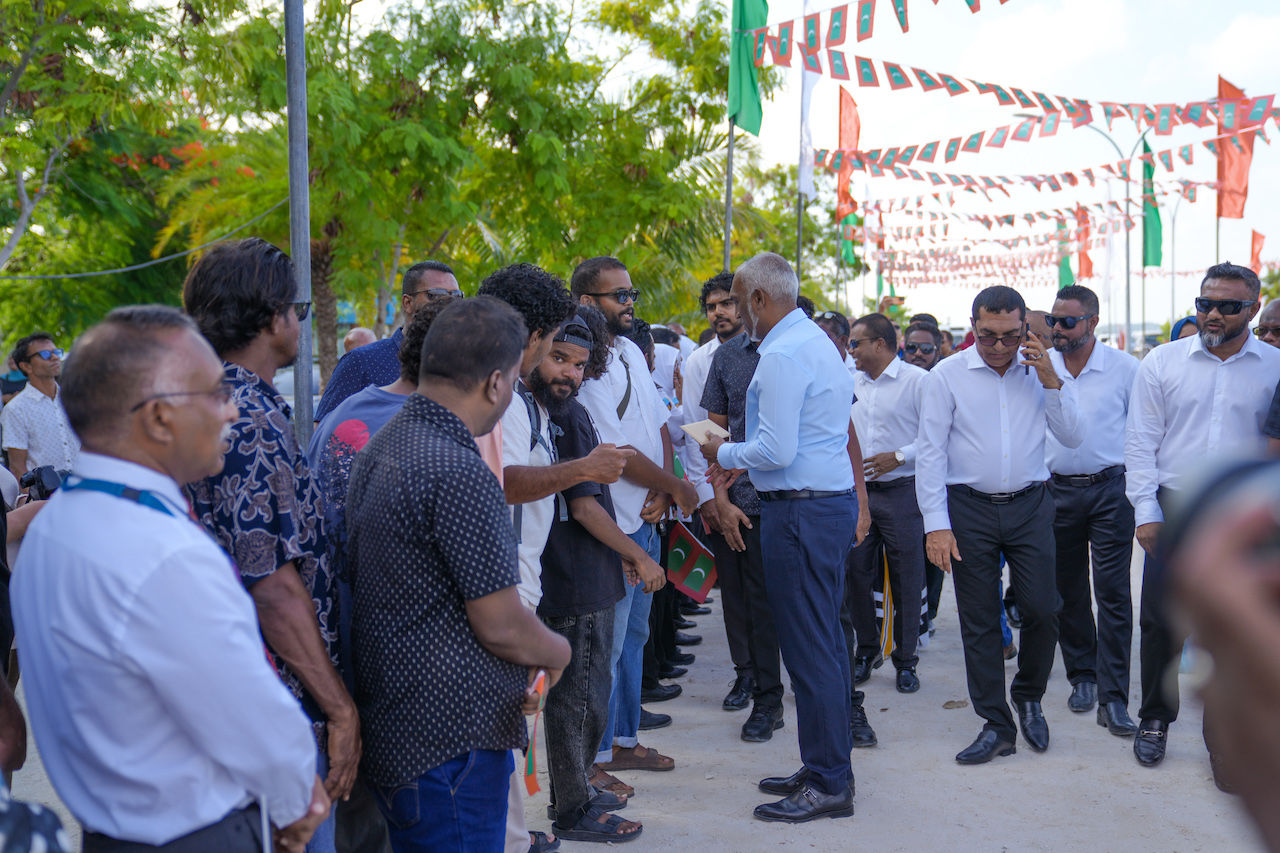
In the letter, the group contested the need for the project. It would not mitigate odour and salinity issues, which they blamed on pollution and illegal waste disposal. Reclamation will worsen the island's freshwater lens and increase the risk of flooding, they warned.
The group dismissed traffic flow and connectivity problems. The existing dirt roads provide adequate access between the link road and the Moolekede region, they said. The letter also raised concerns about "misallocation of financial resources while more pressing matters are left unattended," referring to persistent power cuts, water supply problems, and inadequate public transport.
Ali Ameel Mohamed, a Project Thimaaveshi member, disputed the designation of the land reclamation as a priority project requiring approval from the central government.
“It is questionable to approve a project without considering the facts of whether it will actually solve the problems of groundwater salination and other problems noted,” he told the Maldives Independent.


Discussion
No comments yet. Be the first to share your thoughts!
No comments yet. Be the first to join the conversation!
Join the Conversation
Sign in to share your thoughts under an alias and take part in the discussion. Independent journalism thrives on open, respectful debate — your voice matters.
Support Independent Journalism
Help us keep the news free and fearless
Give once
$
or
Become a memberfrom $5/month