
Murdered Bangladeshi's family awaits promised blood money for three years
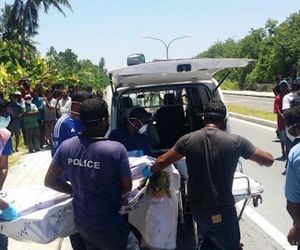
Badshah Mia was brutally killed in his sleep in June 2015.

Artwork: Dosain
01 Jun 2025, 18:48
Mohamed Al-Amin checks his phone every morning, hoping for news that never comes. Three years after the Maldives criminal court ordered blood money for his father's murder, the 23-year-old school teacher in Bangladesh is still waiting for justice – and for monetary compensation that could transform his struggling family's life.
Badshah Mia was brutally killed in his sleep in June 2015. Despite the family's wish to bring the body home, he was buried in Laamu Gan, hundreds of miles away from home across the Bay of Bengal. Al-Amin, who was 14 at the time, could not afford the journey to say goodbye.
"My father was the sole breadwinner in the family. We used to live well with his income, but after his death, we are deeply broken and are living in misery," Al-Amin told the Maldives Independent.
The news shook the working class family from the Kapashatia village to their core. His mother Mst Aysha and two elder sisters, Mst Kanika and Afroga, were left with unanswered questions and scant hopes for justice.
"It is hard to even explain how it felt. We were very sad and our family got very depressed. We suffered very much. My mother worked very hard to support the family and to support [Al-Amin's] education," Afroga Begum, Badshah's daughter, told the Maldives Independent.
His mother tried to support Al-Amin's studies by sewing clothes to earn an income. Al-Amin finished school and completed a diploma and degree in engineering. He paid college fees by going door-to-door tutoring others. He used the rest of his small income to help his mother.
"My mother is currently ill. I am currently working as a teacher in a private technical school in [Dhaka]. It has become very difficult for the family to survive with the income I get from here," he said.
Hoping for a job with better pay, Al-Amin is taking evening classes for a Bachelors Degree from a private university. His two elder sisters are married and live with their families. But they are also struggling, Al-Amin said. Afroga, a garments worker in Dhaka, sometimes helps Al-Amin with expenses.
Blood money
Ali Hamza, a Maldivian man from Gan, was found guilty of quasi-intentional homicide (qatl shibh amdh) over Badshah's murder. Unlike intentional homicide (qatl amdh), the victim's family cannot seek the death penalty (qisas or retaliation in kind) in such cases. The family was instead offered the option of seeking blood money (diya) – a form of compensation under Islamic shariah where the perpetrator or their family provides financial compensation.
Diya for murder is 100 camels or the equivalent monetary amount. In 2021, the Maldives Supreme Court set diya at MVR 1 million (US$ 64,850). This amount may be increased by a third if the punishment grading is raised.
On February 24, 2022, Hamza was convicted based on his confession, phone call records, detailed scene of crime reports and drawings, and the testimony of police officers and three secret witnesses. He was sentenced to 12 years and six months in prison.
Badshah's family joined the sentencing hearing via video conference from the Maldives High Commission in Dhaka. Each family member told the judge that they wished to seek blood money.

The criminal court ordered the payment of MVR 1.3 million to the civil court within three years. After issuing the sentence, Judge Ali Adam allowed the family to ask questions. Al-Amin said it was finally over and he prayed for his father as the family broke down crying.
Three years and three months since then, the family remains in the dark with very little information about the case. Al-Amin tried contacting the respective High Commissions in Dhaka and Malé to no avail.
Case in limbo
Despite the convict declining to appeal, Badshah's case remains unresolved in the Maldives judiciary. After the trial concluded, the Prosecutor General's office appealed the lower court decision, seeking to overturn Hamza's guilty verdict in favour of a ruling for intentional murder.
Since the PG did not seek a stay order to halt the criminal court's sentence, Badshah's heirs are entitled to file a civil court case for enforcement of the blood money order. However, Al-Amin and his family have been unaware either of the status of the case or Maldivian legal procedures. The family has not been advised about their legal options.
At the last appeal hearing on May 20, prosecutors argued that the circumstances surrounding the murder needed to be taken into account. Badshah had been sleeping and defenceless when Hamza struck him on the head with a piece of wood multiple times, opening a gash that led to his death.
But since a piece of wood is not a lethal weapon that could kill a person, Judge Ali Adam had ruled that intent to kill could not be proven under shariah requirements for qatl amdh, which carries a qisas sentence and requires proof beyond any doubt. The court passed the judgment for unintentionally causing the death of another using means capable of causing injury but not necessarily death.
Night of the murder
Badshah worked as a farmer and a labourer in Laamu Gan after moving to the Maldives in 2008. Shortly before his murder, he began working for a Maldivian man named Thoha Waheed, who offered to renew his work visa in exchange for taking care of his house in Gan.
According to Al-Amin, his father trusted Thoha. But before the job transfer, Thoha asked Badshah for a large sum of money - close to MVR 19,000 - to sort out his documentation.
When the money was paid, Thoha called Al-Amin and informed him that Badshah would be staying at his house in Gan until he returns from Malé after arranging the work visa.
But on the next day, Thoha called Al-Amin with the devastating news.
"That night my father was at his house and the next day he called us and said your father has been killed. We couldn't believe it. Later I found out that the Bangladesh High Commission contacted us and they also said that a Maldivian citizen had killed Badshah Mia without any fault," Al-Amin recalled.
Despite his father's "good relationship" with his Maldivian employer, Thoha later denied taking any money from Badshah and refused to give it back to the family, Al-Amin alleged.
Hamza was arrested on June 19. He confessed to the murder during a remand hearing at the Laamu Gan magistrate court, explaining in detail how he killed Badshah.
On the night of June 10, Badshah was sleeping on the verandah of Thoha's house. By his own admission, Hamza climbed a tree and over the wall into the house. He was intoxicated after sniffing glue out of a can. He used a four-feet-long piece of wood to beat Badshah on the head three times. He then stole Badshah's phone and placed a pillow on his face before fleeing, throwing away his can of dunlop and discarding the SIM cards in the phone, which he later sold off.
Nearly a decade since that violent night, the ongoing legal proceedings have left the family in limbo as their wait for closure stretches into the tenth year.
"We are struggling very much now. My mother is very ill and I am not able to provide advanced medical treatment that she requires," a teary-eyed Al-Amin said. "Currently, I am in a situation where I cannot even afford to go back to visit my mother for the Eid holidays."

Discussion
No comments yet. Be the first to share your thoughts!
No comments yet. Be the first to join the conversation!
Join the Conversation
Sign in to share your thoughts under an alias and take part in the discussion. Independent journalism thrives on open, respectful debate — your voice matters.
Support Independent Journalism
Help us keep the news free and fearless
Give once
$
or
Become a memberfrom $5/month