
Tourist entitlement: Maldives is not your content set
From whale sharks to public beaches, visitors push boundaries.
27 Jan, 15:17
Responses to the video were outraged. One commenter remarked that it was heartbreaking to watch such a recurring pattern of shark tourism. Wildlife should not be paying the price for bucket lists and deserved better treatment, said another. Yet amidst the criticism, a tourist who appeared in the video asked for a copy of the footage without the overlay text so that they could post it on social media, with no apparent concern for the message of the video, and no regard for the fact that they had openly admitted to breaking rules in a foreign country.
The video showed a relatively small, young whale shark in South Ari Atoll struggling to swim as it was crowded by a swarm of tourists and surrounded by boats that were speeding towards it. The animal had surfaced to feed and bask in the sunlight, a natural behaviour essential for its wellbeing, and something it was struggling to do on this occasion.
Drone footage captured the chaotic scene, and quickly went viral, shared by multiple individuals and organisations globally. The video was overlaid with the text "crying while recording this", with the caption describing the unsafe and unethical behaviour that was witnessed by the videographer. It also highlighted the breaking of several conservation laws for the South Ari Marine Protected Area (SAMPA).
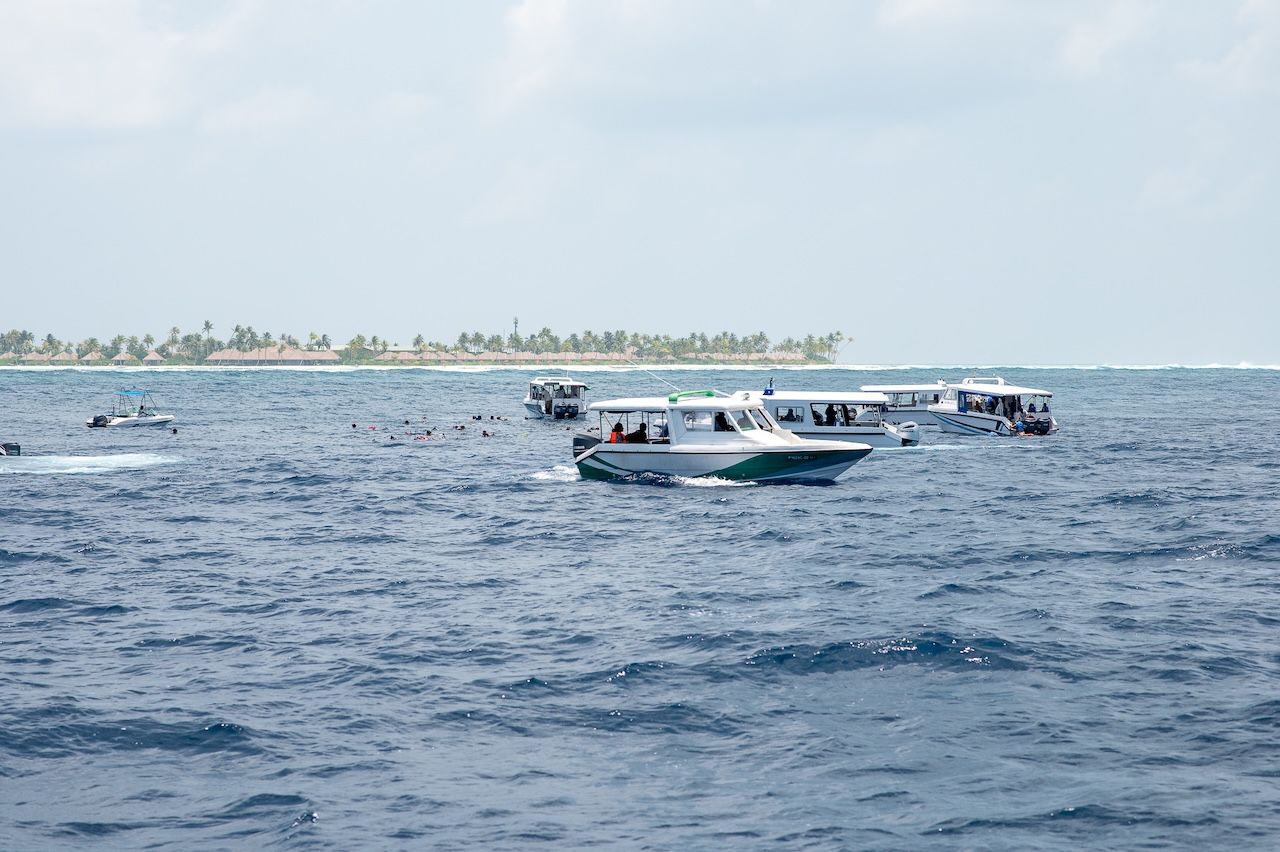
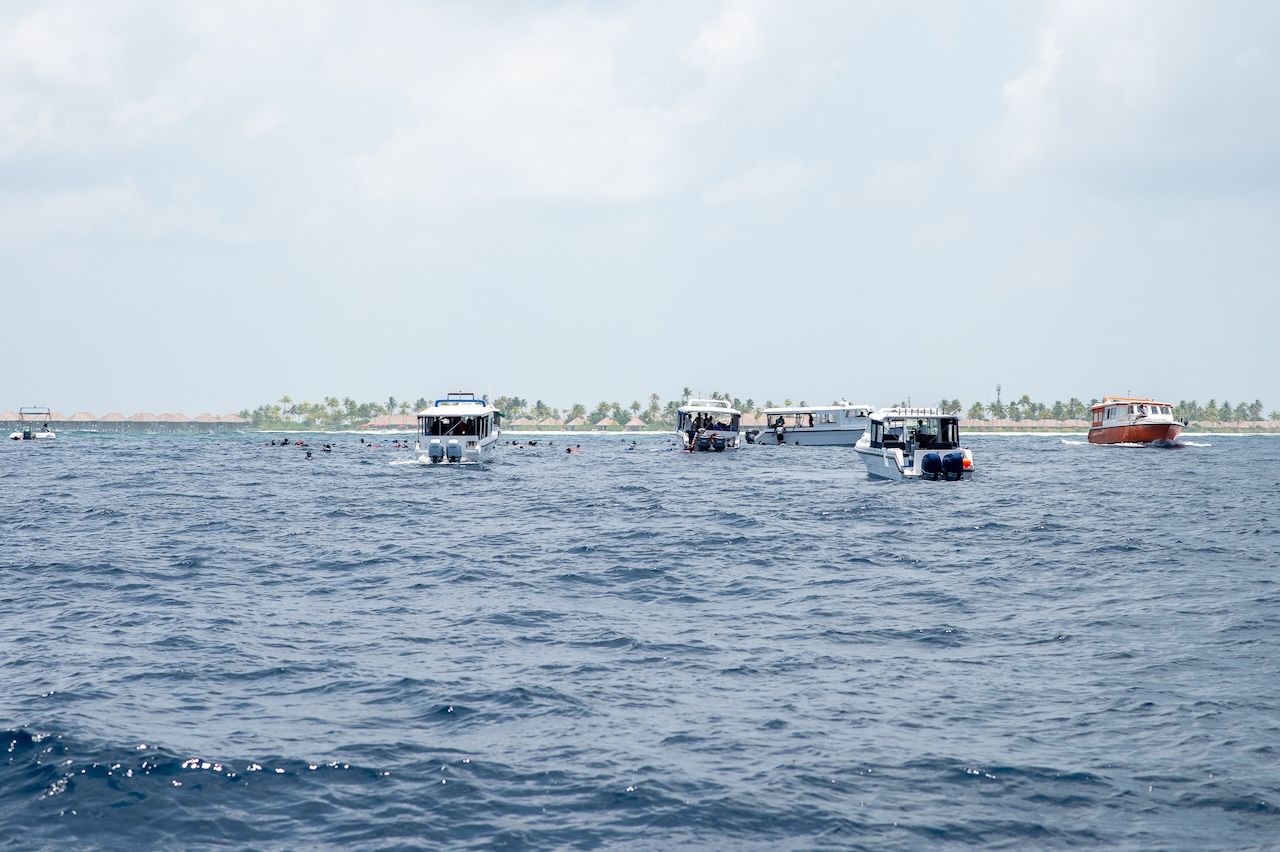
Currently, only five vessels, six with a ranger's boat included, are allowed within 250 metres of the shark. Within 50 metres, which is considered engaging in the encounter, all engines must be switched off and propeller guards have to be on. Swimmers and divers must keep a strict distance of four metres from the head and tail of the animal. They must avoid swimming in front of or over the top of it, and not obstruct it in any way. No flash photography or selfie sticks are allowed.
While the video post concluded by urging viewers to boycott whale shark tours, the comment asking for clean footage displayed the mindset behind the prioritisation of content over animal welfare coming from tourists themselves.
Although tour operators have a duty to enforce ethical rules, their livelihoods are reliant on these excursions, and the demand from visitors to see a whale shark regardless of the impact remains high. Rangers tasked with enforcement operate with limited budgets and staffing, and vast areas to monitor, making consistent oversight difficult even when regulations are clear.
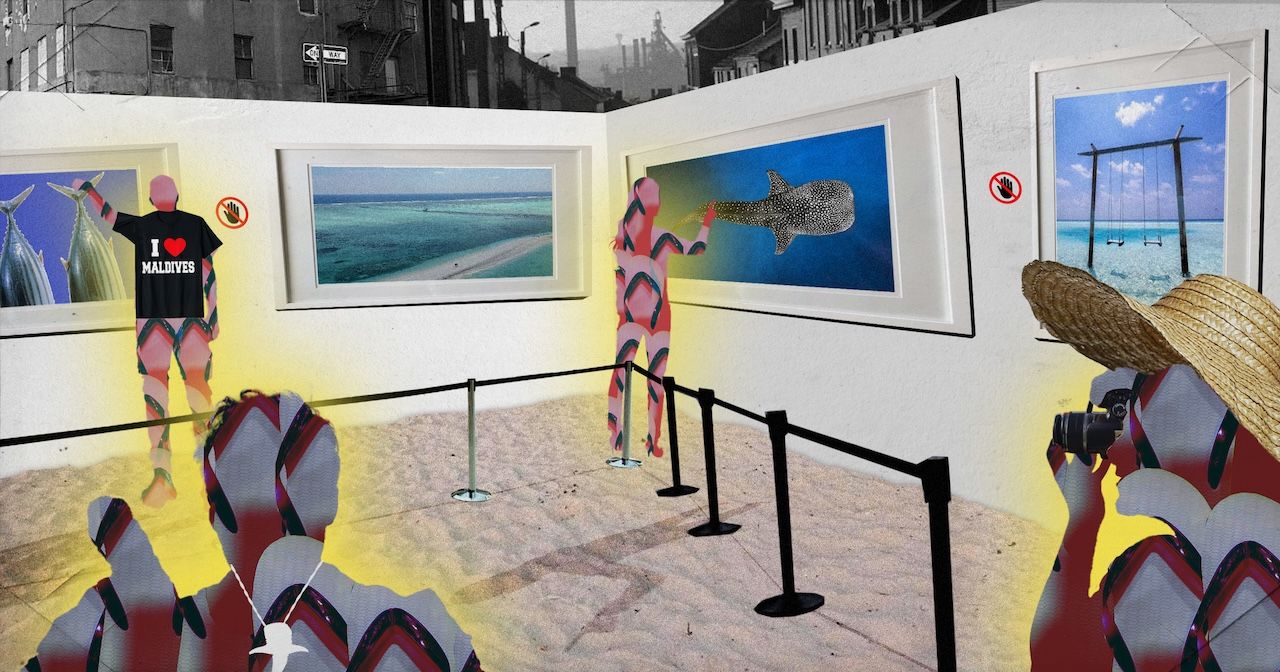
This sense of entitlement exhibited by many tourists extends beyond wildlife tours to public spaces.
Last February, residents in Thulusdhoo reported a group of tourists recording pole-dancing content on local, non-tourist beaches, despite being asked to behave and dress appropriately in those areas. A tourist who confronted them shared an eyewitness account with me. Not only was this uncomfortable and disruptive to the local community, it also unintentionally undermined the work of locals and expatriates who run respectful yoga and wellness classes in the area, as movement-based practices become viewed under the same lens regardless of context.
Other local islands report an increase in tourists wearing bikinis in areas where they are disallowed, and several cases of women going topless on public beaches. Similarly, some adult content creators, including those using platforms such as OnlyFans, have used public areas as their backdrop, including explicit content filmed on local islands, residents of Ukulhas and Rasdhoo told me. These incidents are not inherently objectionable in private settings, but become problematic when imposed on shared spaces with no regard for customs, laws or community consent.
One adult content creator posted extensively about an incident at the airport in which sex toys were confiscated upon entry. Her complaint was that the police did not accept her explanation that she needed them for work, and that she was unaware they were prohibited, something that basic research would have clarified. The incident revealed an assumption that personal or professional needs should supersede local law. She subsequently posted swimming naked at the Vaavu shipwreck and posing nude at the Fuvahmulah thundi.
In addition to the previously described whale shark encounter, ethical lapses across wider shark tourism continue to occur. Touching and feeding sharks is illegal, yet is still flouted to meet guest expectations, regardless of safety concerns or disruption to animal behaviour.
This deliberate ignorance of the law, evident in both visitor entitlement and the tourism industry's accommodation of it, forms a system reminiscent of postcolonial critiques. Visitors are often able to enjoy privileges, even unlawfully, with little to no consequence, while locals must navigate these same rules carefully every day. When incidents provoke public backlash, responsibility frequently falls on local operators rather than on the tourists themselves.
The rise of social media has intensified these dynamics. Platforms reward attention-grabbing content, incentivising tourists to push boundaries. Algorithms do not account for environmental stress, legal violations or social impact. As a result, behaviour that might once have been private or contained becomes global, normalising disregard for community and wildlife. It is a contemporary iteration of historical patterns in which the Global North extracts value from the Global South while externalising costs.
Tourism dependency creates structural inequality. Local operators and communities may be reluctant to enforce rules strictly, fearing loss of income or access to influential visitors. International influencers bring visibility and revenue, and their behaviour is often excused, while communities, including expatriates living locally, absorb the social consequences. Ecosystems are left with the environmental cost. The system rewards commodification at the expense of comfort, safety and consent.
Consent is important in this context because it applies to spaces, animals and communities as much as to bodies. Public beaches and shared areas are places where families gather and children play. When these spaces are turned into content sets without regard for communal boundaries, consent is violated. Wildlife, unable to advocate for itself, depends entirely on the enforcement of rules designed to protect it.
Ethical tourism requires awareness and a willingness to defer personal wants to the rights and wellbeing of host communities and environments.
This is not an argument against travel, nor an attempt to shame adult industry workers. It is a call for awareness, accountability and ethical engagement.
The Maldives is not an empty stage waiting for tourists to bring it to life. It is a country with communities, laws and ecosystems that deserve respect. When tourists crowd whale sharks, occupy public beaches without consent, or film sexualised content on local islands, they replicate historical patterns of extraction and entitlement rooted in imperial and neocolonial systems. These behaviours also risk fuelling calls for stricter conservatism, increasing restrictions on locals and harming the country’s international image. They penalise those tourists who do follow the rules and engage with care.
Ethical and sustainable tourism requires recognising wildlife and shared spaces as sentient and valuable, rather than props for social media. Without this shift, the long-term exploitation of ecosystems and communities will permanently alter the Maldives, making tourism itself finite.
Sophia Nasif is a British-Maldivian photojournalist based in Malé, focusing on culture, environment and anthropology in the Maldives. She is the Ocean Culture Life ambassador for the Maldives, a member of PhotoAsia's Decoding the Anthropocene cohort, and a Revolutionary Storyteller for Photographers Without Borders.
Discussion
No comments yet. Be the first to share your thoughts!
No comments yet. Be the first to join the conversation!
Join the Conversation
Sign in to share your thoughts under an alias and take part in the discussion. Independent journalism thrives on open, respectful debate — your voice matters.
Support Independent Journalism
Help us keep the news free and fearless
Give once
$
or
Become a memberfrom $5/month