

Five days in Yunnan: notes from a guided tour of China
Sixteen Maldivian journalists, two mysterious government escorts.

Artwork: Dosain
01 Aug 2025, 16:14
I am curious about Yang and Zhang, who were they, exactly? On WeChat, the Chinese embassy in Malé had only mentioned that they will accompany us on our trip.
The China Eastern flight lands gently in the soft morning light in Kunming, the capital of Yunnan in Southern China. Our hosts Yang and Zhang await us holding a sign at the arrival area. Yang seems far too cheerful for the time of day, making small talk while herding all of us towards the waiting bus.
Yang is a woman in her late forties or early fifties. She seems enthusiastic, a little scatterbrained. She speaks with a heavy Chinese accent but it's not too hard to decipher. This morning, at half past six, she is dressed in sensible clothes, a little drab if warm.
Zhang meanwhile is young, quiet, and speaks when spoken to. She is the last to board, seeing to it that all sixteen of our delegation are accounted for. She wears a black faux leather dress that gives off a gothic vibe.
On the bus to the train station, we pass the glass and concrete expanse of the China Eastern Airlines company. Soon, the city reveals itself with huddles of high rises, clean roads, and greenery. A very favourable first impression. Before long though, several rundown buildings make an appearance. All is not so rosy.
The security at the train station is more thorough than at the airport. Two rounds of ID checks, the first including a body and baggage check that flagged a colleague's suitcase thinking it had aerosol. Everyone, including the elderly carry cards that allows them through the checkpoints. Like most of us, the Chinese do not seem to care about compromising privacy for convenience and security.
The journey to LiJiang is extremely scenic, revealing rich greens, jade-coloured rivers, and tree-covered mountains capped by white wind turbines.
At LiJiang City, we meet our tour guide Bruce Lee, who wears an intricately embroidered black dress with a red sash around his waist. Bruce looks Indonesian and says he's from the dominant ethnic group of the city called the Naxi (pronounced Nashi).
In my hotel room (everyone gets individual rooms) I look out the window at the surroundings. It's picture perfect. In the distance, a mountain peak soars towards the sky. Trees stud the grounds outside. There are no high rises here following a government ban after the great earthquake of 1999. In the following years, LiJiang, which was up till then a fairly remote location, became very accessible. Like the Maldives, tourism is a key industry here, with about 20 million tourists, mostly from other Chinese cities, coming by each year to enjoy the cool summer weather.
At lunch, we feast on roast duck, beef, stewed vegetables and rice in a stunning local restaurant that flaunts a lovely indoor garden. Not all of the Maldivians are happy however, and most of my colleagues eat little, already pining for the food at home.
Our schedules are packed, 6am mornings and 12am nights are the norm on the trip. We get a couple of hours each night to explore the city on our own, without our escorts. Neither Yang nor Zhang are overly intrusive, but they try to ensure we stick to the schedule. And in the following days, they learn that Maldivians are not exemplars of punctuality.
Later, we're given tours of the native Naxi villages Yu Hu and Baisha. Their rough stone and wood buildings are charming, but all function as commercial spaces. In Yu Hu, we dance with a group of villagers and learn to write in Naxi hieroglyphs on handmade paper. These thin, finely textured sheets are produced the traditional way from the roots of a plant that's resistant to insects and age. It's paper with a history spanning three millennia. Yet though their traditions appear to thrive, they have the feel of performances, existing not for the Naxis but for tourists such as us. The villages, with their countless shops and restaurants and stalls, are like Maafushi writ large.


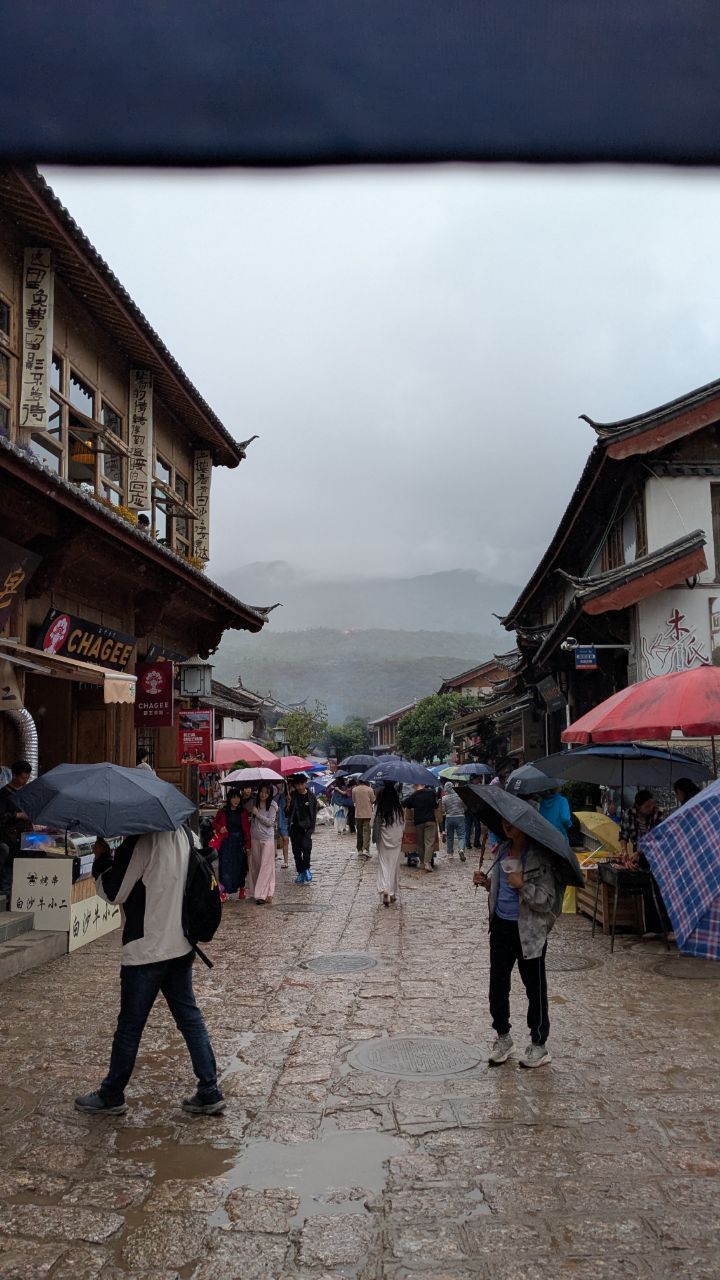


On the bus back from Baisha, I sit next to the chatty Yang, who is in fact a high-ranking official at Yunnan's foreign ministry. She asks for my thoughts on the experience so far, and I tell her it feels a bit put on. She nods, and says her hometown, Dali, also in Yunnan, has old districts that are more authentic that I should visit next time.
Following our tours of the old villages, we make a visit to a hydrogen powerplant on the outskirts of LiJiang. It's a 250-million-yuan facility dedicated to exploring hydrogen fuel as part of a wider government effort to transition to green energy. The wind turbines I saw on the train to LiJiang help power this plant, which also uses solar energy to separate hydrogen and oxygen from water via electrolysis. Engineers on site tell us they are testing the commercial viability of this project. Currently, the facility helps power several public buses in LiJiang city.
The crux of the trip, a meeting with the province's largest news agency, takes place on the third day, about 24 hours before our departure. It's at the sprawling Yunnan Daily complex in Kunming. But, as we're informed by senior journalist Jerry Wang, the daily also produces content for South and Southeast Asia, with dedicated desks for Vietnam, Cambodia, Thailand.
At their offices, we're also met by the daily's deputy director, Zhang, and have a roundtable discussion on how to adapt to the new media environment, producing quality content in the age of AI, and how best to engage with a Maldivian audience. A colleague mentioned that unlike Korea or Japan, China is mostly unknown territory for Maldivians – there is very little Chinese content accessible to us whereas J/K-Pop, anime, manga, and K-Drama are popular here, especially among the youth.
That evening, we have a multi-course meal at an upscale restaurant with Yang's boss, Mr Wen, a vice director at the Yunnan foreign ministry. He delivers his address to us in Chinese while a young woman translates it to us in impeccable English. He points out that the Kunming-Male connection was the suggestion of a former deputy speaker of the People's Majlis. During dinner, Mr. Wen speaks in English to the journalists beside him. He also has a parting gift for each of us – a lucky charm that doubles as a pen drive.
On the final night, some colleagues and I visit a mall near our lavish Wyndham hotel, where we once again have individual rooms. At the mall's top floor, there's loud dance music, and many teenagers and tweens, dressed provocatively in cosplay outfits and baring their many tattoos, hang out in the corridors, shouting and playing around.
At the end of the trip, I ask a fellow media colleague their thoughts.
"I'd always thought the Chinese were unfriendly," they said. "But I felt quite welcome here. I think the Chinese youth are generally very good natured and approachable. A dude helped me find a taxi, translating on his phone. Many people have helped me find my way around the city, too."
Another colleague, a young woman who wears the hijab says she didn't feel like she stuck out too much.
"Some people asked me if I was from the UAE or Malaysia, but they were just curious and friendly. I didn't feel like they were judging me at all," she says.
"They love their country much more than we love ours," says a colleague from a recently established news agency. "We should be promoting our culture more, but to do that we have to understand it and love it."
The China I got is different from what I had imagined. It's an interesting first impression, there appears to be genuine hospitality, ethnic diversity, and room for youth to express themselves. Given the brevity and curated nature of our trip I of course have no idea about the real China, but it is a country I would like to get to know better in the coming years.
Discussion
No comments yet. Be the first to share your thoughts!
No comments yet. Be the first to join the conversation!
Join the Conversation
Sign in to share your thoughts under an alias and take part in the discussion. Independent journalism thrives on open, respectful debate — your voice matters.
Support Independent Journalism
Help us keep the news free and fearless
Give once
$
or
Become a memberfrom $5/month

