
"No one is going to empower us": how the Maldives' only four-term councilwoman claimed real power
Fishermen call her for help. Female councilors seek her advice.

Artwork: Dosain
28 Oct 2025, 15:22
When fishermen in Meemu Mulah need help weighing their catch or planning Fishermen's Day, they don't call the men on the island council. They call Saamiya Mohamed. She's the one they trust to solve their problems.
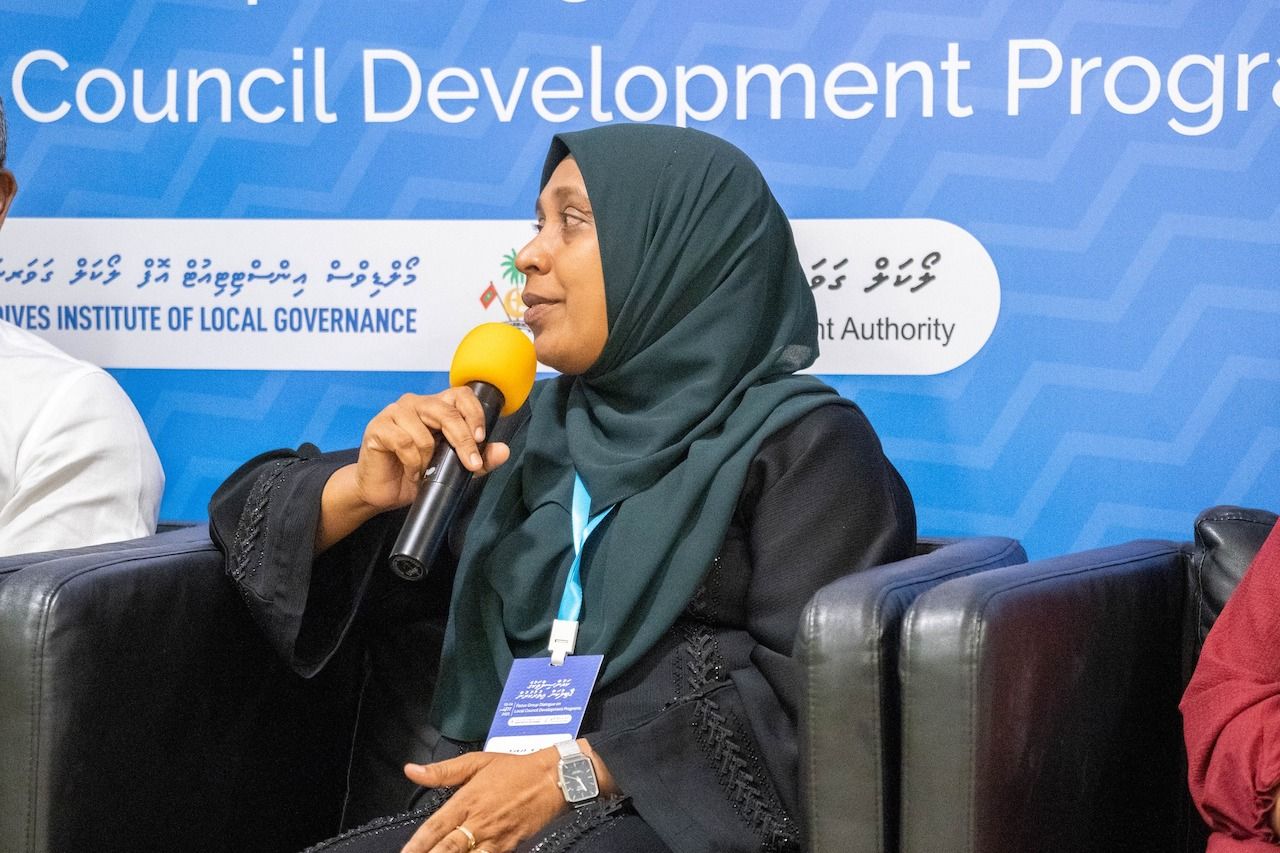
Saamiya, the council’s vice president and one of two female councillors, was tasked with overseeing the 100 percent male-dominated fisheries sector when work was divided among the five council members. The council president also directs any fisheries-related issue to her.
"Even if there's no boat for weighing fish on this island, all the captains of the island's speedboats and dhonis will call me even with regard to their difficulties, saying 'please help with this and have that arranged.' I personally arrange boats by calling MIFCO [Maldives Industrial Fisheries Company] and such places," she told the Maldives Independent.
Saamiya is the only councilwoman in the country to have served four consecutive terms. She was elected long before a quota introduced for the 2021 polls reserved one-third of council seats for women, pushing up the proportion of female councillors from six percent to 40 percent.

The empowerment playbook
At a time when many female councillors tell stories of being sidelined and relegated to stereotypical tasks, Saamiya stands out for more than her longevity. She has transformed what many now see as a quota seat into genuine power, managing a male-dominated sector and becoming a mentor to councilwomen she has befriended over her four terms in office.
When women tell her that men don't allow them the opportunity to make decisions, Saamiya often shares the same advice: "First know that you have the authority and power to agenda the issue you want. When you send it to the president to put it on the agenda and if he refuses to include that, there are also steps that can be taken for that."
Councilwomen should actively join debates instead of just nodding assent or declaring support for proposals, she continued, noting that the agenda for council meetings are shared 48 hours in advance.
"Use the right you have to consult with anyone you would like to – women, different parties, ask parents where they stand, what their thinking is, find out. That's your responsibility. Come to the meeting with those opinions. Tell them you met with this percentage of people within this timeframe, that this was their opinion," she said.
She stressed the importance of seeking public opinion in small island communities: "This is the way we can raise our voice, how we will be accepted by the people."
While the Decentralisation Act gave women a seat at the table, Saamiya argued that female councillors have yet to take full advantage and claim the power granted by the law.
"We need to grab that opportunity in a more meaningful way than this. In every sense, when implementing decisions made on an island, we need to move forward holding on to that power," she said.
As gender equality is enshrined in laws and the constitution, women cannot be legally deprived of their right to speak, Saamiya observed.
"The law says I have freedom to express my opinion. I have the responsibility, I'm given the authority to speak about what I propose. Even the [council] president cannot prohibit that," she said.
"No one is going to come to empower us. We have to empower ourselves."
Tea or kurumba?
When delegations visit from the capital, it is often councilwomen who serve kurumba (coconut juice) as welcome drinks, and organise receptions and evening tea.
But councilwomen should be alongside their male colleagues instead, Saamiya said.
Like her female peers in councils across the country, Saamiya is familiar with being asked to do domestic work at the office. During her first term, the council ran a guesthouse. The two female members on the council swept and cleaned and looked after everything.
"We ourselves believed this isn't something we need to do. How do we find a solution? So we discussed it in the council and hired an employee for that place – for sweeping and cleaning, and when people come and go, to do those things. That's the point where we didn't have to do it anymore. So we are the ones who will think for ourselves, we will look at things for ourselves. If we give up those things, the difficulty will also fall on us. We need to shake the dust off and stand up for ourselves," she recounted.
However, a gendered perception of certain kinds of work as either male or female persists, Saamiya noted. But when it comes to making arrangements for an official visit, "can't a man also manage it?" she asked.
In the Mulah council at present, implementation is carried out by council staff under the supervision of the secretary general, who then reports back to the council members on progress.
Despite challenges, Saamiya backed the quota system to address the lack of opportunities for women to participate in politics, despite views to the contrary within the party system and island communities.
"The opportunities available to women are very limited. So if we are guaranteed 33 percent through a law, having women present in decision-making and policy-making on every island is something I had hoped for and a very big change that has come," she said.
Saamiya said she realised the importance of a woman's voice and female participation in every island-level decision early on in her career. Even on decisions made from a parent's perspective, a mother and father would see things somewhat differently, she suggested.
The first generation of women elected to local councils in 2011 entered office with a deep communal spirit and prior experience of community organising, she suggested. However, female candidates now emerge through parties. They are valued or chosen based on party loyalty or their political rhetoric, she added.
Saamiya praised the Mulah council president for what she called inclusive and collaborative decision-making "with our advice and consultation." Despite winning election on opposing party tickets, Saamiya said she is able to work with the council president towards the island's development without major disagreements.
"I work with party affiliation in elections. As a member contesting an election, I am a political person. But after being elected and coming to the position, I am a citizens' person," she explained.
"We don't come to do party work. We come to serve the people. So both the president and I come to work for Mulaku's development."
Behind the scenes
Growing up watching the Women's Development Committee undertake ambitious community projects inspired a deeply social spirit in Saamiya. She joined the committee in 2008 and became vice president by 2010. She went on to work with women's rights leaders like Aneesa Ahmed, who encouraged her to run in the country's first local council elections in 2011.
"In truth, I ran for council to see what I could contribute by participating in social work," she recalled. With strong community support, she emerged as a Dhivehi Reyyithunge Party candidate.
Saamiya highlighted the support from her husband and family as essential. Her biggest support comes from her mother, who is helping her raise her children as she juggles motherhood and council work. Aside from party members, the most prominent person in all her campaigns has been her husband, she said.
The life of a councilwoman is tough and busy but it is a job that more women can do, she said, proudly listing the academic achievements of three of her children.
Saamiya credited her rare feat of securing four consecutive terms to her connection with the people of Mulah.
"Everything the people ask for may not happen. But not being able to make it happen and trying to do it are very different things. Even if it doesn't happen, knowing that I'm trying to do it is a source of contentment for the people, right?"
Discussion
No comments yet. Be the first to share your thoughts!
No comments yet. Be the first to join the conversation!
Join the Conversation
Sign in to share your thoughts under an alias and take part in the discussion. Independent journalism thrives on open, respectful debate — your voice matters.
Support Independent Journalism
Help us keep the news free and fearless
Give once
$
or
Become a memberfrom $5/month