
Three years, eight pillars and a roof: Muizzu's house for 2040
The president's anniversary pitch and Republic Day speech in full.
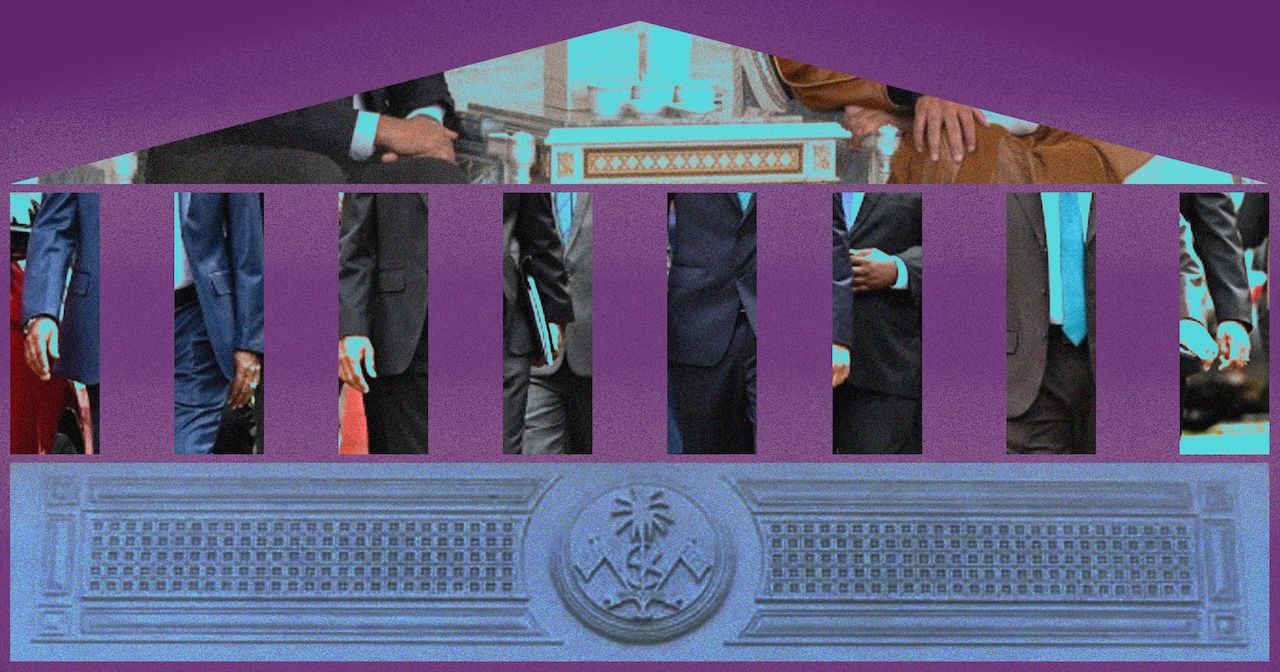
Artwork: Dosain
1 hour ago
President Dr Mohamed Muizzu used his Republic Day address on Thursday night to set out in prose the vision for 2040 he had sketched on a flip board two days earlier.
The official ceremony, where he conferred state awards, was held eight days after Republic Day, which marks the abolition of the sultanate on 11 November 1968. It followed a speech of more than 90 minutes last Tuesday to mark the third anniversary of his administration.
In that speech, Muizzu admitted that major infrastructure projects had "stalled badly" for lack of money, as debt repayments fell due and the Middle East war forced the government to prioritise health and education. He set a target of finishing at least 70 per cent of signed projects by the end of 2027, having previously pledged to complete every project started under his administration within his five-year term.
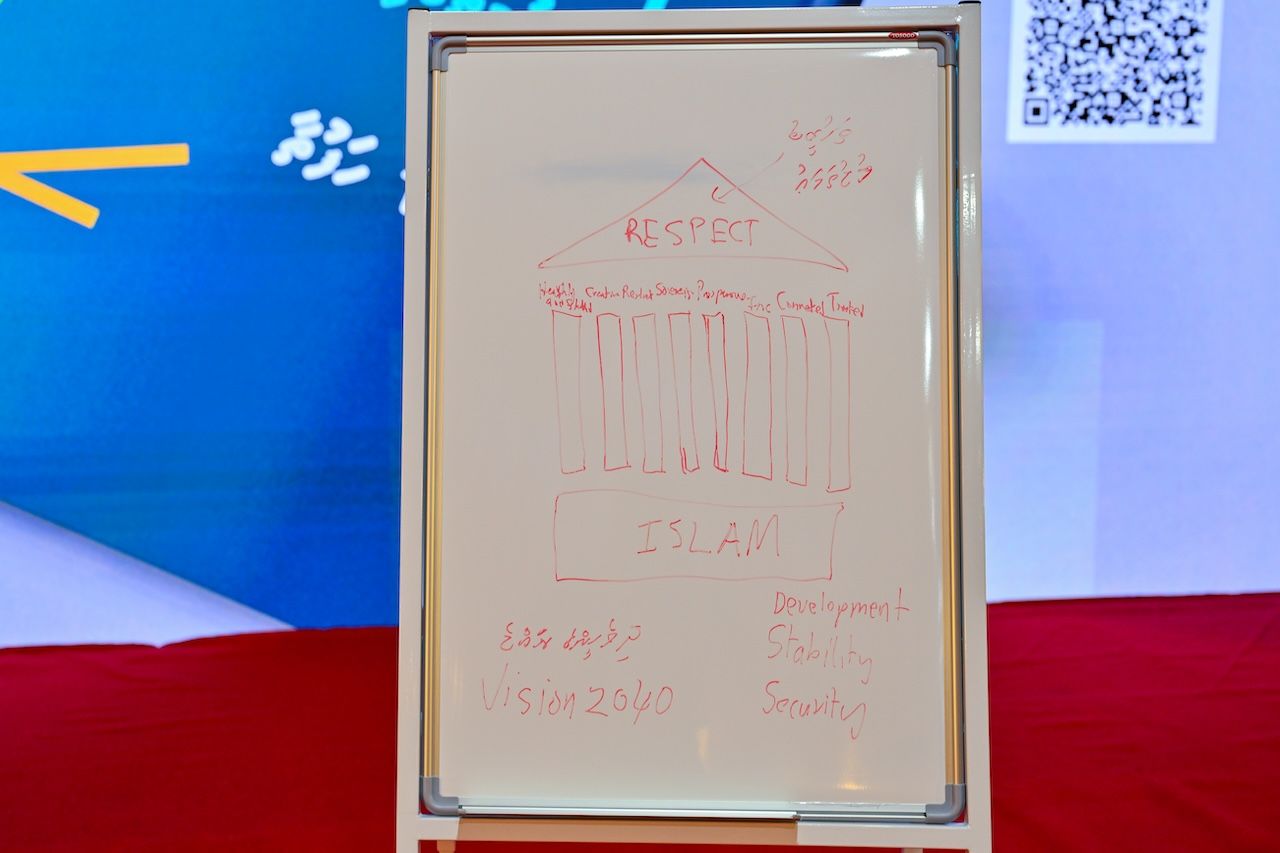
But the moment that drew the most attention came when Muizzu, a civil engineer by training, took a marker to a flip board. He drew the nation as a house: Islam as the foundation, eight pillars and a roof labelled "Respect". The pillars stood for a prosperous, sovereign, resilient, inclusive, connected, trusted, creative, and healthy and skilled Maldives. Beneath the house he wrote "Dhiveheenge Raajje" – the Maldivians' Maldives – and "Vision 2040" with "Development, Stability, Security" alongside.
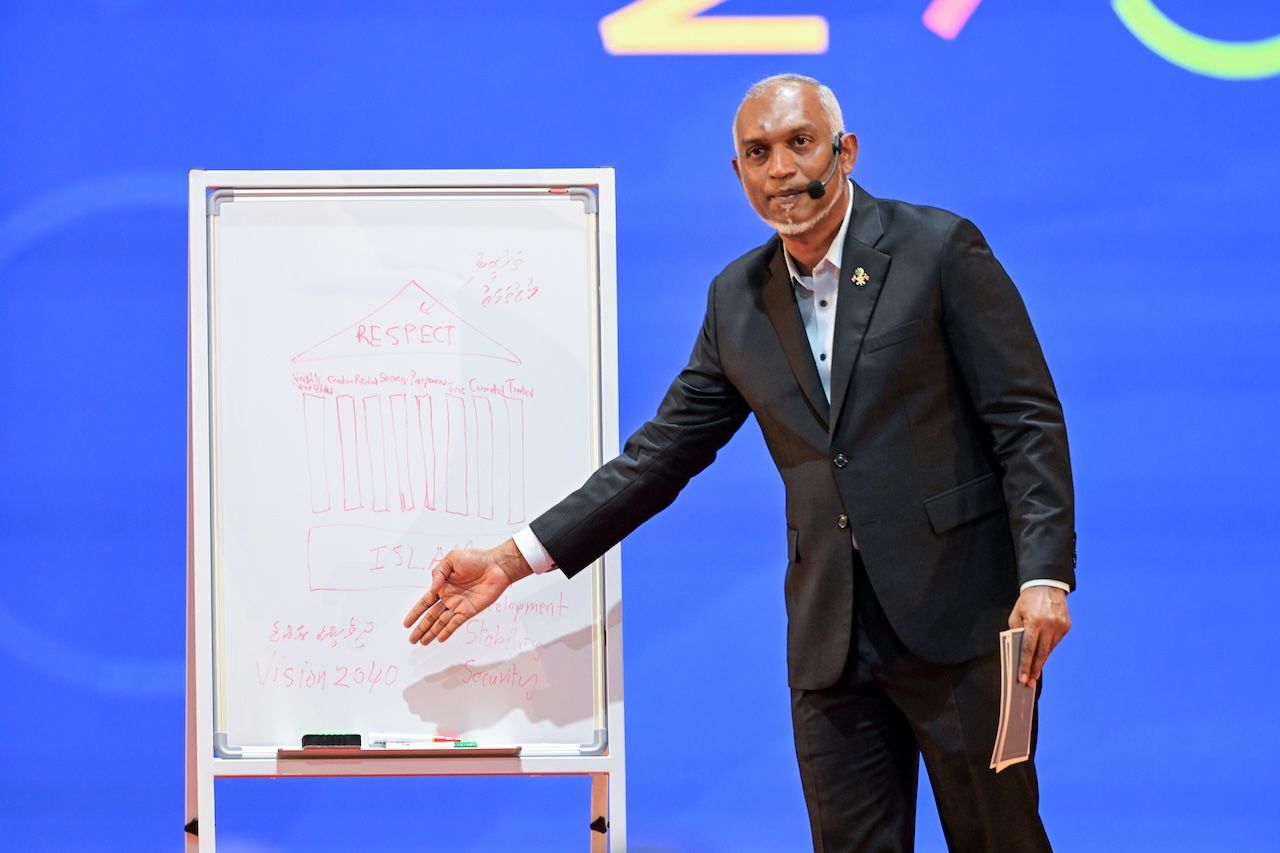
Explaining the roof, Muizzu said intellectual development mattered alongside tangible development, and that a society without respect would be in disarray. He wanted the creative digital economy to contribute at least 15 per cent of GDP by 2030, and likened his push for airports and transport links to the canals and railways that came first in industrialising countries. "Transport is one of the most important foundations of development," he said.
The sketch soon became a target for critics. A cartoon published by Adhadhu showed a long-nosed president drawing pillars labelled hypocrisy, fraud, corruption, waste, lies, bribery, incompetence and injustice under a roof marked "Failure", resting on an L-shaped sofa. Its caption read "Illusion 2040".
Much of Muizzu's speech dwelt on sovereignty. Changing the country's territory now requires a three-quarters majority in parliament and a public referendum, Muizzu said, and even a single foreign soldier needs parliament's approval. The Maldives would have close ties with every country "except for just one country: Israel", he said, adding that "big players" in the resort industry had warned him the Israeli passport ban would ruin tourism. He called concerns over the Rasmalé deal baseless, saying the bill before parliament bars alcohol sales, pork and casinos. Investors who could not accept those standards would not invest, "and that does not matter to us".
Muizzu cast himself as "someone who does very unpopular things", citing the vape and generational tobacco bans, the Israeli passport ban and a rule change requiring scholarship students who do not come home to repay the state. He urged the public to shun disrespectful speech, the theme of a campaign launched days earlier. "If such a thing comes on TV, switch it off," he said. The opposition "must itself be opposed," he said.
New pledges included two non-repayable housing grants to cover the five per cent equity banks require: MVR250,000 (US$16,200) per person to buy a flat and MVR200,000 to build on one's own land with MVR750 million set aside in the 2027 budget. He also said a bill would create a "check and balance" system so that no law contrary to Islam could be made.
In Thursday's shorter and more formal address, Muizzu said his development policy would rest on "spiritual human-building" founded on Islam and "material, urban building". The goal was a "civilised society" built "on the strong foundation of Islam," he said, closing with the motto: "Dhiveheenge Raajje – a civilised society."
Muizzu recalled reforms by the first two presidents that he said had been resisted by a few: Mohamed Amin Didi's push to educate girls and to cut wide roads through narrow island alleys, and Ibrahim Nasir's introduction of engines on fishing boats, which opponents warned would scare the fish away. He also recalled a foreign feasibility study that concluded tourism could not take root in such a scattered archipelago. Each time, the far-sighted majority was proved right, he argued.
The address ended with a prayer that "all those who obstruct the peace of the Maldivian nation and work to destabilise the progress of the Maldivians' future" be granted good sense. On Tuesday, Muizzu had dismissed concerns over the Eagle Hills deal to develop Rasmalé as unfounded.
Below is a full translation of the Republic Day address:
Indeed! Jumhoor means the majority of the people. A jumhooree government – a republic – is one run by a leader chosen by decision of the majority of the people. In today's language, a democratic government. Republic Day in the Maldives is therefore a day that marks a democratic decision of the Maldivian people. It was the day Maldivians had their say on who rules the Maldivian state. A day to reflect on the Maldivians' yesterday, today and tomorrow. This special ceremony is held in that special sense. For that important purpose. Republic Day is a day for Maldivians to reflect on the Maldivian nation. A day to contemplate the nation's future. To begin, I consider it my greatest pleasure to extend the greetings and best wishes of this day to everyone. And to congratulate those who received various awards and honours at this ceremony. So, extending Republic Day wishes to all my beloved Maldivian brothers and sisters, I repeat my congratulations and best wishes to everyone who earned these honours.
Beloved people of the Maldives:
Ours is a very fortunate country. We Maldivians are a people whom Almighty Allah has placed in peace and plenty. Reflect on the 4,000-year history of the Maldives and the experience of some other countries in the world, and you will feel this very keenly. Until quite recently, the Maldivian nation numbered fewer than 100,000 people. So the extraordinary fact that Almighty Allah ordained that a people so few in number should defend so vast a country and remain free for thousands of years is a most exalted blessing. A great joy. Every day, at every moment, what you hear and see in the media is the pain and misery of countless people in the world who have no free land of their own and suffer for it. By the boundless mercy of Almighty Allah, the condition of Maldivians is entirely different. For that, we must always be grateful to Almighty Allah. We must direct our thoughts and deeds towards defending our nation and homeland. We must make room for our progress and for a civil and civilised life.
Our forefathers came this far by keeping this sharp national consciousness alive. By facing the upheavals that swept the world. By achieving proud advances. In religious terms, very soon after the holy religion of Islam was revealed and spread to the different corners of the world, we chose that noble faith. Why? Well, because Islam is the most perfect and true religion. Whatever colours there were in the environment around us, we Maldivians paid them no heed.
What we gained was the care of Almighty Allah, Lord of the worlds. Look at the constitution, too, and it is the same. It was we who completed and adopted the first complete written constitution in this region.
Even within the culture of the monarchy of the time, this constitution guaranteed many rights for the Maldivian people. In the same way, after that, a sudden revolutionary change was brought to the Maldivian system of government, and we became a people who run the Maldivian state with a leader elected by the people. Looking at the historical stages, we moved from monarchy to elected monarchy, from elected monarchy to republican government, and later on to the principles of modern democracy we have now. What these things show, therefore, is that Maldivians – the Maldivian people – are a peerless model people at finding every path that is most beneficial to the Maldivian state, most advantageous to the Maldivian nation and most likely to bring progress and development to the Maldives, and at moving forward on those paths.
Indeed! In any case, at this moment we are gathered at a special ceremony held on the occasion of Republic Day, and in spirit, with the feelings of Republic Day. So what we should reflect on today is this: how shall we meet the days ahead? What are the ways that would most benefit all Maldivians, or the whole Maldivian nation, in the days to come? What role can each of us play in resolving the difficulties and hardships that have confronted us since time immemorial?
As we ask these questions, I believe it is important to revive some memories of the republican journey we have travelled so far. For example, did not some people rise up to obstruct some of the developments His Highness Mohamed Amin Doshimeyna Kilegefaanu wanted to bring to the Maldivian nation? But when we reflect today, we see that the decision made that day by the many, wishing the nation well, brought far brighter, far more luminous eras to the Maldivians' future than the feeble thinking held by those two or three people. Recall the challenges he faced when he began advocating that girls must receive an education. Some people at the time began telling the public it was something that must not be done in any way. In the end, Mohamed Amin secured that good fortune for Maldivian children by submitting a bill to the People's Majlis and giving it the force of law. Now consider it today and see for yourselves! Did educating girls bring harm to the nation and the religion, or benefit? Mohamed Amin was the first president of the Maldivian republic. Of the burdens he shouldered for the Maldivian people, I have mentioned only this one. In the end, is not every achievement, every joy, for the people? For the whole Maldivian nation?
The second thing I want to note is the work of cutting roads on the islands of the Maldives, which he also began. Before that, what the islands of the Maldives had were narrow, cramped lanes. The broad, spacious roads are the roads cut on his orders. One group opposed that too. However, Maldivian citizens who were more far-sighted, more discerning and more thoughtful than those opponents welcomed his civilising reform. It was the people who came out and built beautiful roads on the islands. Now consider this too. Did the islands of the Maldives come to ruin because they have beautiful roads? Or did it bring those islands ease and beauty?
The second president of the Republic of Maldives was His Highness Ibrahim Nasir Rannabandeyri Kilegefaanu. A new opportunity for development that he worked to introduce to the Maldives under his leadership was fitting engines to fishing boats. What happened? A few people fiercely rejected this too. They said the noise of the engines would make the fish flee. That no fish would be caught. But what did the right-thinking people do? The skipper of the Ummeedhu dhoni in Lhaviyani Naifaru fitted that boat with an engine. Many other boat owners began fitting engines too. Now, when we think about it today, what kind of feeling does it leave us with? Was fitting engines to boats really something that brought such misfortune?
Having spoken about fisheries, I would also like to say a word about tourism. In some of our neighbouring countries, by around 1966, tourism suited to that era had been formally organised and was under way. How did we Maldivians act? First, a study was carried out through foreign experts to ascertain feasibility. What was the conclusion of their report?
That because the Maldives is a country of islands scattered far apart, given the challenges of transport, tourism was not an industry that could be established and developed in the Maldives. But what was the civilised, practical answer we Maldivians gave the world? Did not two or three Maldivian citizens take the lead and begin some hard work in a very ordinary way? And likewise, did not a small number of Maldivians generate mockery and words of contempt? Yet look at the result of new urban and economic thinking like this! Is tourism not, today, one of the tallest pillars of the Maldivian economy?
Looking at these events, too, it is clear that many Maldivian citizens have always welcomed progress and modern development. It is clear that they put national thinking first. For the Maldivian people have given great encouragement to awareness and civic development. The Maldivian people want an aware Maldivian nation. The Maldivian people want a Maldives that has attained civilisation.
I believe the Maldivian people still stand on that truth today. And my development policy will be founded on these two points: spiritual human-building based on Islam, and material, urban building. Ushering the Maldives, smiling, into a new era within the framework of Maldivian nationhood. Turning into reality the vision of making this proud and beloved Dhiveheenge Raajje [the Maldivians' Maldives] a civilised society: one built on the strong foundation of Islam, where freedom, sovereignty and independence are protected; where individual and national prosperity is assured; that is resilient in the face of various climatic and global impacts; that is inclusive in every sense; that is connected in every way; that has an innovative, productive economy; where holistically healthy, educated and skilled citizens live; and that is trusted in the broadest sense of the word.
Honourable and beloved Maldivian citizens:
The soul of a nation's progress is always this kind of hopeful thinking within it. Thinking well of things. The steadfast resolve not to stand still out of fear of suspicion. Along with that, the stability within that nation. The unity within that nation. The harmony among its people and their keen grasp of a single goal. The spirit, enthusiasm and determination to keep moving forward in that way.
This is the national character of the beloved Maldivian people. This nation has been handed down to us as a civilised nation, heir to a strong civilisation. This nation has reached us as a peaceful and safe nation. As a united people who speak one language, follow one religion, share one culture and come from one origin. The root of all the progress the Maldives has achieved is this hopeful thinking of the Maldivians. This brotherly unity. The peace that exists in the Maldives. The solidity of the national ranks of the Maldivian people. So on Republic Day, what we must revive is the spirit of saying yes to the peace of the Maldivian people's future. On Republic Day, our feeling should be the hope of seeing, tomorrow, a Maldives that is developed and enriched by modern progress. On Republic Day, the prayer in our hearts should be a sincere prayer that all those who obstruct the peace of the Maldivian nation and work to destabilise the progress of the Maldivians' future be granted good sense. On Republic Day, our motto should be: "Dhiveheenge Raajje – a civilised society."
May Almighty Allah grant us success in this way! May He keep this beloved homeland forever free! Ameen!
Discussion
No comments yet. Be the first to share your thoughts!
No comments yet. Be the first to join the conversation!
Join the Conversation
Sign in to share your thoughts under an alias and take part in the discussion. Independent journalism thrives on open, respectful debate — your voice matters.
Support Independent Journalism
Help us keep the news free and fearless
Give once
$
or
Become a memberfrom $5/month