
"I refused to yield": a Maldives Supreme Court justice's final stand
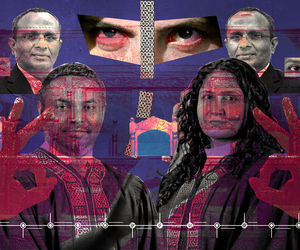
Dr Azmiralda called her impeachment a "coordinated framing operation."

Artwork: Dosain
26 May 2025, 14:07
On 14 May 2025, the People’s Majlis voted to remove me from my position as a Justice of the Supreme Court of the Maldives, on baseless accusations and following secretive proceedings that disregarded the law and violated my rights. This decision was made by a supermajority of Majlis members belonging to the ruling party – fully aware that I have committed no wrongdoing, yet acting as political pawns, blindly pressing buttons on instructions of their political masters rather than fulfilling their duties to the people.
On 26 February 2025, when the Supreme Court decided to proceed with a hearing in a major constitutional case – despite the state requesting that the hearing be cancelled – Justice Mahaz Ali Zahir, Justice Husnu Suood, and I were suspended from the court. To this day, I have not been provided with any documents that form the basis of the suspension. While the Anti-Corruption Commission notified the Judicial Service Commission on 26 February that a criminal investigation was underway, they have not questioned me even once.
When we received news of our suspension that day, Chief Justice Muthasim Adnan said that we would not be returning to the court again. As I watched him take a “farewell” photo with one of the other suspended justices, I felt then that I would likely be removed from the bench the very next day. A group of people willing to suspend Supreme Court justices under the pretext of a criminal investigation would clearly not hesitate to cast aside due process and act however they wanted.
Shortly after being informed of my suspension, I received a notice from the JSC stating that a disciplinary case was being investigated against me. I responded within 12 hours, sending a letter denying the accusations, expressing my willingness to respond to the charges in an open hearing, and noting that attempts had been made to influence me. Simultaneously, I filed a complaint with the Anti-Corruption Commission against the individual who attempted to exert that influence.
Since 26 February 2025, I have had to endure a difficult journey filled with challenges and obstacles. The reason for this is because there is no rule of law in Maldives. Had the rule of law prevailed, the fundamental rights enshrined in the constitution would have been upheld. I would not have been subjected to an investigation, and something that never happened would not have been distorted into something that did.
The Judicial Service Commission restricted one of the most fundamental rights guaranteed by the constitution – the right of every person to seek assistance from legal counsel. By withholding essential documents necessary for my defence, the JSC violated my right to adequately respond to the allegations made against me. It refused to admit the full body of evidence presented in my defence and ultimately made its decision in the manner it wished, even if there wasn’t any actual proof.
What concerned me most was the decision to conduct all proceedings behind closed doors. The People's Majlis judiciary committee followed the same pattern. That committee went so far as to deny me the basic right to appear before it and defend myself. Due process and fundamental rights have become a mockery. After denying me the opportunity to answer the charges, the chair of the judiciary committee could only justify the decision by citing the actions of the 19th parliament – as if continuing a culture of wrongdoing by the previous parliament is the duty entrusted by the people to the 20th parliament. The judiciary committee could not even agree with the tone of legal advice from its own counsel general, which had clearly stated that the JSC acted unlawfully in initiating the disciplinary case against me.
As both the JSC and the judiciary committee include members who claim to possess legal knowledge, one must ask: why was it necessary to conduct disciplinary proceedings against Supreme Court justices in secret? The answer, to me, is obvious – had the hearings been public, it would have become clear to the Maldivian people that the charges against me were entirely fabricated, a fiction constructed by state institutions. The manner in which this process was carried out is beneath even the standards of the 19th parliament.
If this was a country where the rule of law prevails, everyone who orchestrated, organised and carried out these proceedings could face criminal charges. Yet leaders and officials in state institutions continue to act so brazenly because they are never held to account. A leader is empowered to be so openly corrupt because those beneath them enable it, because people in positions of power and employees do not oppose it and stay silent. On the rare occasions when action is taken against a leader, the long arm of the law rarely extends to those under them who actively help carry out unlawful acts. If it did, they might hesitate to so openly crush the rule of law.
Today, my family and I have become victims of a coordinated framing operation, blatantly carried out by certain government officials using state resources. Since it is only the Judicial Service Commission responsible for investigating disciplinary issues related to judges’ conduct – and while such matters do not go to trial – the commission violated multiple fundamental rights by conducting secret hearings in my case and issuing a verdict in complete secrecy. The hearings were never made public because there were no genuine questions about my conduct. If the charges against me had any merit, they would not lose the opportunity to publicly display and humiliate me in an open hearing.
The judiciary committee decided not to summon me because they intended to suppress my voice – to cover up the coordinated corruption and abuse of power by state institutions. There was much I would have said about what transpired since the day my husband was arrested.
I have never called, nor asked anyone else to call, a criminal court judge or any judge of any court to exert influence. In my entire life, I have called a criminal court judge only once – about two years ago – when I contacted the chief judge to inquire about their online hearing arrangements as I was preparing for a judicial symposium.
The defence I submitted to the JSC included clear evidence of how I learned about my husband's release from detention: a copy of the release order showing the exact time of release, my phone call logs, and my WhatsApp messages. I submitted a list of witnesses who could speak to my conduct on that day and attest to whom I spoke. I also submitted evidence showing that the charges were aimed at influencing my role in a constitutional case before the Supreme Court.
Despite all this, the JSC had already decided how they intended to conclude the matter. The truth is, had they genuinely considered the evidence, there would have been no disciplinary case left to pursue. From the outset, the investigation report made it clear that the outcome had been predetermined. It included false claims attributed to Judge Ibrahim Zihunee, stating that I had instructed another justice to contact him. These claims were not even in Judge Zihunee’s actual statement. This strongly suggests that the report was prepared before he ever gave his statement to the JSC. From that moment, it became obvious which direction the commission was taking – otherwise, they could not have fabricated something the judge never said or mentioned in his statement. That is not something that could have been written by mistake.
Over the course of my 24-year career in the legal and judicial field, I have never once abused my position for personal gain or attempted to influence anyone. No one can produce evidence to suggest otherwise. Today, I am being removed from my position as a judge over a case that had already been decided before I was even investigated.
Despite all of this, I refused to yield to influence, pressure, or political alignment. I chose to stand and defend myself – not because I was unaware of how it would end. I chose to fight knowing the outcome. I did not want to take the easy way out. I wanted the whole country to witness how vulnerable judges have become. I wanted people to see the tactics politicians use to bend those entrusted with upholding justice. To expose how judges are threatened with disciplinary action, and how their careers can be destroyed for refusing to comply.
The constitution envisions a separation between the executive and legislative branches. But judicial independence remains limited. Administrative and financial decisions about the judiciary are made with the involvement of the other two branches. Unlike individuals in the executive or legislature, every judge’s job is at the mercy of politicians. It doesn’t matter whether a judge commits any form of misconduct. If their rulings displease those in power, they become targets of harassment and intimidation. They are defamed, subjected to baseless accusations – you might be accused of being bought for a packet of rice, or accused of influencing another court’s judge to save a husband accused of a crime. An ordinary citizen can speak out and take legal action against defamation. But for a judge, simply defending oneself becomes a disciplinary issue. Judges may receive high salaries and be entrusted with great responsibility, but even the most basic constitutional rights can be stripped away from them. When it comes to rights, judges are more vulnerable than ordinary citizens.
By bringing reform to the constitution, the judiciary – tasked with delivering justice – must be empowered to do so free from undue influence. It must remain independent of the executive and legislature, while also being held accountable through appropriate checks and balances.
Today, I’ve lost my position as a judge – not for the first time. Nine years ago, on 12 May 2016, I was forced to resign as a High Court judge after facing difficulties in continuing my employment, caused by the same group of politicians in the current government. At the time, they used my young children to put me in that position. I was indefinitely transferred to the High Court southern branch in Addu. At the time, I wrote letters to the Supreme Court, the Judicial Service Commission, the People's Majlis, and the president, but received no response from any institution. I note with concern that some members who were in the Majlis then are also in the current Majlis.
This time, they used my husband. False criminal allegations were fabricated against him and weaponised against me – tarnishing both our reputations. This time, I submitted my grievances to the Judicial Service Commission, the Anti-Corruption Commission, the Maldives Police Service, the president, the People's Majlis, and the Maldives Bar Council. I did not send a letter to the Supreme Court this time because the court had already bid me farewell.
In addition to Maldivian institutions and judges, my legal counsel, Ibrahim Shameel, has brought this matter to the attention of many foreign organisations and institutions, including the UN Special Rapporteur on the Independence of Judges and Lawyers, several embassies established in the Maldives, the Commonwealth Lawyers Association and LAWASIA. Many foreign organisations have issued statements condemning what happened as an attack on the judiciary of the Maldives.
None of the institutions in Maldives have reviewed the complaints I submitted. The Judicial Service Commission chose to fabricate a false report to remove me from my position. The Anti-Corruption Commission chose to take part in corruption and paralyse the Supreme Court. The Maldives Police Service found no grounds for a criminal investigation. The Bar Council didn’t see an ethical issue in a lawyer-elected JSC member participating in the removal of Supreme Court justices based on false claims. The People's Majlis saw a case that followed due process, and not one that trampled on the constitution and violated fundamental rights.
Just a day before I was suspended – on 25 February 2025 – my husband, Dr Ismail Latheef, through his legal counsel, submitted a complaint to both the judiciary committee and national security committee of the Majlis. He alleged that false charges had been filed against him and that his case was being used to influence me and force the Supreme Court to deliver rulings favourable to politicians in power. He also submitted complaints to the National Integrity Commission and the Police Professional Standards Command. Not a single institution blinked at how state resources were being abused by politicians..
I did not get justice today. But make no mistake: this is not just a personal attack on me, or on justices Mahaz Ali Zahir and Husnu Suood. This is an attack on the judiciary itself. Crippling the Supreme Court is no trivial matter that can be brushed aside lightly. I hope that on the day that rule of law prevails in this country, that in light of all the letters I have sent, all the leaders and employees in various positions who took part in crushing the Supreme Court will be investigated and brought to justice.
From the beginning, I’ve understood clearly who controls the balance of power in the three branches of government as well as the so-called “independent” institutions. Were it not for the detailed reporting by every mainstream media outlet in the Maldives, I would have been quietly removed long ago. I’m thankfull to the press for the attention they gave my case, and for ensuring the truth reached the public despite immense pressure. I believe the media took such an interest because, as the fourth estate, their role is to uphold the constitution, defend the rule of law, and protect the rights of the people. They didn’t take my side – they stood on the side of justice.
I can prove every claim in every complaint I have submitted to the Judicial Service Commission, the Anti-Corruption Commission, or any state institution. The evidence exists. What’s missing is an institution willing to look at it, investigate it and ensure justice.
I wouldn’t wish on anyone what my husband and family have been put through because of my profession. I only hope that one day, those who misused the state resources to frame innocent people will be held accountable – and face the punishment they deserve after a fair trial.
I wish the best for the Maldives, and for the judiciary – always.
The above statement was translated from Dhivehi.
All comment pieces are the sole view of the author and do not reflect the editorial policy of the Maldives Independent. If you would like to write an opinion piece, please send proposals to editorial@maldivesindependent.com.
Discussion
No comments yet. Be the first to share your thoughts!
No comments yet. Be the first to join the conversation!
Join the Conversation
Sign in to share your thoughts under an alias and take part in the discussion. Independent journalism thrives on open, respectful debate — your voice matters.
Support Independent Journalism
Help us keep the news free and fearless
Give once
$
or
Become a memberfrom $5/month