
Politics of radicalisation: how the Maldives is failing to stem violent extremism
Azim Zahir explores the array of factors that fuel radicalisation in the Maldives; “block thinking” that does not bother to understand complexities; government’s trivialising of the issue; instrumentalisation of religion by all political parties; and the “Islamisation” of gangs.
25 Apr 2016, 09:00
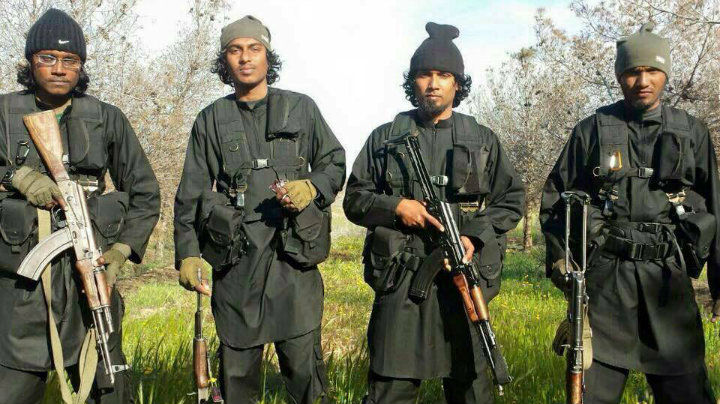
Twelve people related to one family from the Maldives left for Syria in December 2015, reportedly to join the ISIS. They included four sisters, three brothers, the wife of one of the brothers, two husbands of two of the four sisters, their two-year son and a six-month old daughter. The family of the eight siblings comes from the remote island of Kondey in Gaaf Alif Atoll with a population of just 544 people. This latter fact may not be significant, as they lived in the capital Malé.
This is just one of the latest reported cases of foreign fighters from the Maldives going to Syria. The Soufan Group, a think tank monitoring the flow of foreign fighters in Syria, says the official count – defined as count based on either government sources, or quoting government sources, or from the UN, or a research or an academic source – for the Maldives is 200.
However, the official Maldivian government count fluctuates between 20 and 100. This month, the country’s Counter-Terrorism Centre said the count was at most a two-digit figure.
Based on media reports of actual cases since 2014, there seems to be a steady flow of Maldivians going to Syria since at least mid 2013. The government has so far failed to stem this flow. But the flow itself does not necessarily show the government has not taken measures against violent extremism. After all, the numbers from other parts like the Western Europe also climbed between 2013 and 2016 despite international efforts to stem the flow.
But when it comes to states like the Maldives gripped by political turmoil, there is a politics of radicalisation that further aggravates the issue. In the Maldives, this politics includes: 1) “block thinking” that does not bother to understand complexities; 2) trivialising of the issue of violent extremism by the government; 3) instrumentalisation of religion by all political parties; and, 4) politics through radical gangs susceptible to “Islamisation”.
Religion’s big story in the Maldives: the context
As far as Islam is concerned, the really big story coming from the Maldives is the fragmentation of religious consciousness. Contrast this with the observation by anthropologist Clarence Maloney in the 1970s: Islam in the Maldives was limited to washing, fasting and praying. What he meant was that Islam was largely a practice. There was no talk. No conversation. No argumentation.
Enter the new millennium. Welcome to the phenomenon of some have called “objectification of Muslim consciousness”. Islam has by now become the contest of vigorous disagreements. Islam is an object of vigorous talk, dispute, and theorisation. It has become even more an object of conspiracy theories and sensationalist journalism.
Disagreements are not just between Salafists and non-Islamist Maldivians. Fragmentations exist within Islamists and Salafists, on issues of women, democracy, human rights, and violent jihad. In short, different groups envision different utopias for the country.
That is the broader sociological reality of religion in the country. We don’t yet know the precise implications of this reality for successful democratisation in the country. We, however, know that most Maldivians support democracy. Most associate it with such notions as freedom of expression and assembly. We also know Islamists have so far failed to translate whatever support their ideology has into votes.
But we also do not know the long-term implications of fragmentation of religious consciousness for broader security for the Maldives and even for other countries, including India. I take up here the story of the unhelpful politics surrounding radicalisation that further facilitates current violent extremism.
The politics of radicalisation
Block thinking and radicalisation
On September 29, 2007, a group of Maldivian violent extremists detonated a homemade bomb at Male Sultan Park, injuring 12 tourists. Since the Sultan Park terror attack, no act of terrorism has taken place inside the Maldives. Maldivians, however, have joined violent jihadi forces in Pakistan, Afghanistan, and now increasingly Syria. It is not clear how, if at all, the people behind the 2007 attack in Malé are connected to today’s jihadists.
According to Maldivians who have joined Al Qaeda’s Jabhat al-Nusra in Syria, the Maldives is not a strategic priority for them. Instead, an Islamic state in the Indian subcontinent, they argue, can be a more fruitful goal. If such an endeavour can be successful, ‘conquering Maldives would be as simple as a blow from the mouth from a mountain of India’.
To be sure, for them, the Maldives is under jahiliyya/irreligious darkness (as in pre-Islamic Mecca), ruled under a taghut/idolatrous system. Maldivians, they believe, must refrain from participating in elections. The reality is: 90 percent voted in the 2013 presidential elections.
At least, then, the Maldivians who have joined al-Nusra don’t support any political party in the Maldives. They condemn President Abdulla Yameen’s government. It can hardly be true the Yameen government or his party, the Progressive Party of the Maldives, directly supports them either.
Moreover, there is an ideological disconnect between these Maldivians in Syria and the modernist Islam espoused by former President Maumoon Abdul Gayoom of PPM. The non-religious modernism of the Maldivian generation educated at the American University in Beirut (which includes President Yameen) is a far cry from the religious ideologies of violent extremism. President Gayoom might have attended rallies by Sayyid Qutb in his student days in Egypt. But ideologically he is closer to the reformist Islam of Jamal ad-Din al-Afghani and Muhammed Abduh that aspired to show Islam was fully compatible with modernity.
The point is Maldivian actors like Jamiyyatul Salaf/Al Asr, Islamist Adhalath Party, PPM, Sharia4Maldives, Maldivians in ISIS and al-Nusra, are not ideologically of the same fold on all issues.
Yet some in the current opposition and sensationalist media reports do not bother to make these discriminations.
That is an outcome of the tendency to lump together all who do not support secularist ideologies in a single fold. That is an example of what Canadian philosopher Charles Taylor calls “block thinking”. Under block thinking, differences and discriminations do not matter. “Islam” is taken as a monolithic unit and seen as somehow antithetical to secular modernity and dangerous to politics. I think there are several dangers associated with this kind of thinking.
Consider for example a possible implication when we lump Maldivian foreign fighters in Syria together. We know that Maldivians who have joined al-Nusra or would desire to join al-Nusra would not necessarily like the ISIS. There is a pretty sophisticated treatise by one of the Maldivian fighters in al-Nusra (who has now died in Syria) decrying ISIS and its ideology of an Islamic State in the current mode. Maldivian fighters who are with al-Nusra continue to portray the ISIS as a deviant group. The implication of this is really huge if one is serious about understanding who may be behind the ISIS or al-Nusra recruitment from the Maldives. It may not be the same group.
Or consider another example. Sheikh Adam Shameem of the Salafi NGO Al Asr is accused of recruiting people for violent jihad without credible evidence. It is true he does not support secular democracy. He may condemn Western atrocities in Muslim countries, or even support jihad in principle. He also made a Facebook remark making a prayer for Muslim foreign fighters, including two Maldivians who died in Syria. But the reality is he has a complex view on jihad, including defensive violent jihad.
Shameem condemned the Sultan Park bomb attack, condemned Maldivians joining extremist groups in Pakistan and Afghanistan, and reasoned the command by an amir as a condition of violent jihad, and argued jihad becomes an individual obligation upon citizens of a country only in cases of foreign aggression (or when commanded by their leader). In another piece he says people should go for violent jihad when requested by the people of a Muslim country under aggression and when the neighbouring countries are incapable of helping them.
Through the failure to make differences we may fail to differentiate between potential allies to stop radicalisation for violent extremism and the real culprits. That’s the first aspect of politics of radicalisation in the Maldives: block thinking, sometimes informed by secularist biases.
Trivialising radicalisation
President Yameen’s government does not of course appear to be seriously working to stem the foreign fighter flow from the Maldives. The fact that at different times, depending on the political platform, the government has said different things about the extent and reality of violent extremism, is a matter of grave concern.
The openness with which some jihadist fighters have operated in social media supporting violent jihad and their continued interaction with local people, is another indication of how radicalisation is trivialised. If an individual like myself (not even with primary focus on radicalisation) could know that an Ahmed Atheeq from Addu atoll went to Syria, and could find out his Facebook page by asking a friend in Addu who knows him personally, and for months could read his Facebook updates supporting violent jihad and encouraging violent jihad, to me, that is an indication of how government trivialises the issue.
This will not be surprising if one takes into account that the police force is disproportionately mobilised to meet the narrow political ends of the government of the day. A counter-terrorism centre was only established in February this year.
Political trivialising of the issue of radicalisation is then the second aspect of politics of radicalisation in the Maldives.
Instrumentalisation of religion
The third aspect of politics of radicalisation is political instrumentalisation of religion in general by all parties.
Politicians instrumentalise Islam in selfish ways. PPM and the Gayooms portray political opponents in the Maldivian Democratic Party as Christian missionaries or anti-Islamic secularists. This is done to incite local religious sentiments.
But MDP, in turn, portrays the Maldives as a hotbed of fundamentalism, encouraged by PPM and/or Islamist Adhaalath Party depending the time and shifting alliances. MDP no doubt uses this approach to solicit international support. This appeals to some Indian and western audiences that see the Muslim world through the War on Terror.
In reality, both PPM and MDP have been ready to make alliances and flirt with puritan Salafists.
Part of this instrumentalisation is to do with the nature of the electoral system. The Maldives has a majoritarian electoral system that requires 50 percent +1 votes to win the presidential election. The winner-takes-all system for parliamentary system also encourages tactical partnerships. This, together with the competitive nature of elections since 2008, have meant that otherwise non-religious parties have a strong incentive to solicit support of every segment of the political and religious spectrum.
The Islamist Adhaalath Party became part of every government not because of popular votes but because of their coalition with major political parties. But parties have also solicited support from more puritan Salafi end of this spectrum that in principle supports violent jihad and portrays Muslim issues in a Manichean worldview of Good (Muslims) vs. Evil (West/Israel).
The outcome of the free reign given to puritan Salafists over the state resources, and other funds and facilitation in exchange of political support, is that Salafi activism and outreach have grown at mindboggling levels.
We do not know the extent of public support for Salafist ideologies. But if one subscribes to some of the Salafist views, even though one may not be a violent extremist, one may be more sympathetic to violent jihad, or one may be more susceptible to religion-based recruitment for violent jihad.
That is, at a minimum, how political instrumentalisation of Islam is related to radicalisation.
Islamisation of gang members
The fourth aspect of politics of radicalisation is related to the rise of gang politics. “Islamisation” of gang members may be the most significant route to the journey to Syria.
An assessment on gangs in 2012 suggests that all political parties use gangs for politics ends. Partly as a result, no government has seriously tackled the issues of youth delinquency and their radicalisation in gangs. But in recent years, gangs are believed to have become dangerous political instruments. It is suspected that politicians sponsored gang members in the murder of parliament member Dr Afrasheem Ali in 2013 (ahead of presidential election primaries) and the abduction of journalist Ahmed Rilwan in 2014.
But this dangerous connection of gangs to politics and related political failure to address the issue, have opened gangs to a totally different and new phenomenon. The concept of “Islamisation of radicalism” explains this: a lot of today’s violent extremists joining groups like the ISIS are already radicals, before they get “Islamised”.
Several Maldivians who have joined the ISIS come from backgrounds of past (non-religious) radicalism, crimes, and gangs. These people were already radicals before they were “Islamised” to become foreign fighters.
The 2012 gang assessment also indicates there were no links between religious figures and gangs (who in fact distrusted the country’s religious scholars). This suggests “Islamisation” of gang members is a more recent phenomenon.
These facets of the politics of radicalisation may not be surprising in a state gripped by deep political turmoil since 2003. But unless this politics of radicalisation is managed, it will be difficult to address the real issue of religious radicalisation and “Islamisation” of non-religious radicals.
Azim Zahir is a PhD student at the Centre for Muslim States and Societies, the University of Western Australia. His research focuses on Islam, secularism and democratisation.
All comment pieces are the sole view of the author and do not reflect the editorial policy of The Maldives Independent. If you would like to write an opinion piece, please send proposals to [email protected]
Discussion
No comments yet. Be the first to share your thoughts!
No comments yet. Be the first to join the conversation!
Join the Conversation
Sign in to share your thoughts under an alias and take part in the discussion. Independent journalism thrives on open, respectful debate — your voice matters.
Support Independent Journalism
Help us keep the news free and fearless
Give once
$
or
Become a memberfrom $5/month