
Maldives in South Asia: Let’s talk about Saudis
“There is a little bit of each other in all South Asian countries but, somewhere along the way, Maldives has been somehow set apart and aside from its neighbours. Their cultural story is not among the threads with which the common South Asian identity is commonly woven today,” writes Dr Azra Naseem.
03 Dec 2015, 09:00
A deviation today from the usual focus on Maldives’ insane politicians: the spread of revolutionary Islamist thought in the Maldives, and some of its regional implications. This week I went to a conference in New Delhi about culture as a factor in regional cooperation in South Asia. These are some of my thoughts and observations from the conference.
Listening to the various papers presented by regional academics, it occurred to me the Maldives figures very little in the conversation around forging a common South Asian identity. This is not to deny there is interest in the Maldives among specialists on regional dynamics—many projects at the Institute for Defence and Security Analysis (IDSA), said to be one of India’s foremost think-tanks, are focused especially on the Maldives. I also met two Indian postgraduate students doing their research on Maldivian socio-politics, and one person who is about to publish a book on the Maldives. No doubt there are many more South Asians with scholarly and policy-level interest in the Maldives. But, the Maldives was missing from the main shared narrative of culture spoken of at the conference. On many occasions, many of the speakers referred to a South Asia where all nations are diverse. A South Asia of pluralist nations are engaged in daily conversations with a thousand different ethnicities, languages, religions, and customs. All South Asian nations, the general consensus seemed to be, are pluralist, secular, and democratic.
The Maldives is none of these things: it is within the throes of a rapid authoritarian reversal; in the process of establishing a Wahhabi and Salafist hegemony; and has rejected democracy as an antithesis to Islam.
If the countries of South Asia really want to form a culturally diverse union akin to the European Union, which is what was envisaged at the conference, the primary requirement is to know, and appreciate, each other’s culture beyond global headlines. Many scholars at the conference told anecdotes about shared borders, languages and religions. They collectively remembered genocides, partitions, bloody wars. There is a little bit of each other in all South Asian countries but, somewhere along the way, Maldives has been somehow set apart and aside from its neighbours. Their cultural story is not among the threads with which the common South Asian identity is commonly woven today.
The same can be said about Maldives’ knowledge of South Asian cultures. The region’s diversity, rich literature, musical and artistic cultures, and even politics, are not part of the everyday Maldivian conversation as they are in other SAARC countries. Once upon a time there was a short-lived period of interest in sharing South Asian culture with the Maldivian population. Anyone growing up in the Maldives in the 1980s would remember Sunare Bangladesh, a song played so often, everyone new the words without understanding a word. There was a whole genre in Dhivehi fiction of translated Urdu and Hindi literature, the high-brow and trash both. My mother had suitcases full of them under her bed, and still wants to see Shah Jahan’s present to Shehezadi.
Today it is a different story. Apart from Bollywood, and Indian daytime soaps, Maldives’ cultural links with South Asian countries has grown narrow and limited. The Indian High Commission in the Maldives holds culture themed events to forge cultural links. But real interest and curiosity about India—even its rich Islamic history—is absent from the conversation. Pakistan appears less close than Palestine. Tens of thousands of Bangladeshi immigrants are seen as alien, not as culturally, religiously, or even geographically close. There are no Maldivian text books that explore cultural and religious similarities, shared histories with the region. There are no literature courses that include the works of great South Asian writers of world renown. No students pour over South Asian thinkers, philosophers or poets. Instead, at present, South Asian culture is portrayed as alien to the Maldivian Islamic culture, leaving out of reach of Maldivians the volumes of Islamic thought and pluralist intellectual discourse that have originated from the region.
Instead, Maldives shut people’s doors to it all, and encouraged what it called ‘religious unity’ first with Egypt, the Gulf states then with Saudi Arabia. Given the lack of such texts and sources of learning, most Maldivians shape their knowledge of the culture of other South Asian countries according to their personal experiences, without exploring beyond. Thus many Maldivians are unaware of the rich Islamic culture in Bangladesh, its thriving secular state, and its many poets and intellectuals—Bangladesh is seen by most through the prism of a dominant prejudice against Bangladeshi workers in the country. Pakistan is seen through the lens of its Madhrasaas, and the many Maldivian students they teach. India is known largely as a country for good medical care, Bollywood, having other Gods, and not much else.
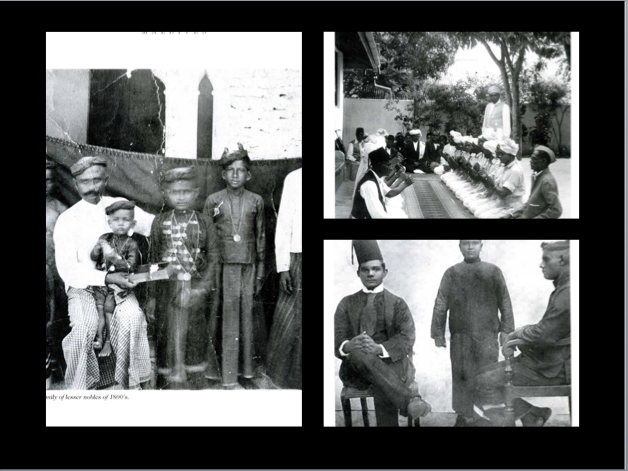
In my presentation at the conference, which was to be only 15 minutes long, it was hard to tell the story of the cultural changes—influenced by Saudi-imported Wahhabism and Salafism—that Maldivian society has undergone in the last decade or so. To make most of the time I trusted the old saying pictures speak a thousand words. I showed participants photographs of visible changes in Maldivian society during the 1970s. I showed Maldivian women wearing Saris. Short dresses. Long dresses. I didn’t have a picture of the Tweety days. I showed pictures of Aminiya students in the 1980s, and at present, pictures I took in 2012 of Maldivian girls from other islands, all wearing headscarves. I showed them women from the Mahasintha, the Sharia marches. I bring up the Maldivian women’s appearance not to explain away the change as ‘extremist’ or ‘radicalisation’ but to demonstrate the astonishing—so visible yet silent—change the Maldives is undergoing. This is not to reduce the changes to simply cosmetic—the visual changes have a multitude of underlying reasons which must be explored in its own right. It was presented as a visual representation of the dramatic change that has occurred at a much deeper level in Maldivian society.
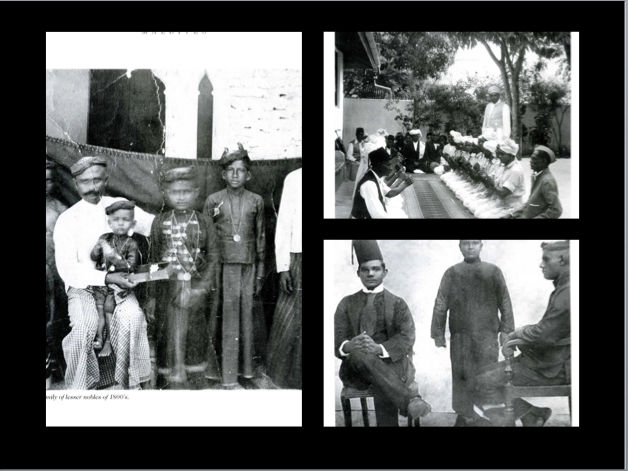
Some pictures of slides from my presentation:
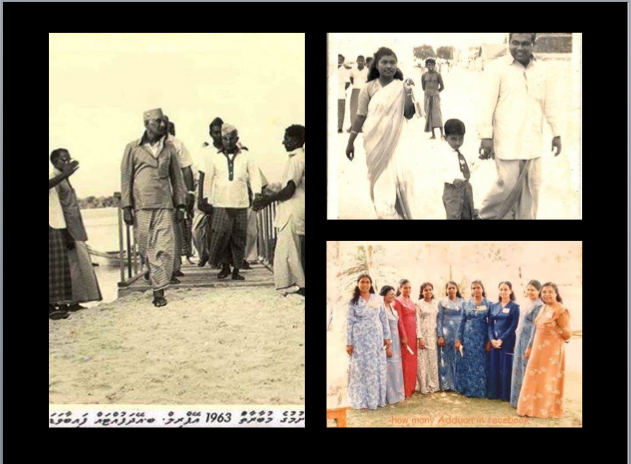
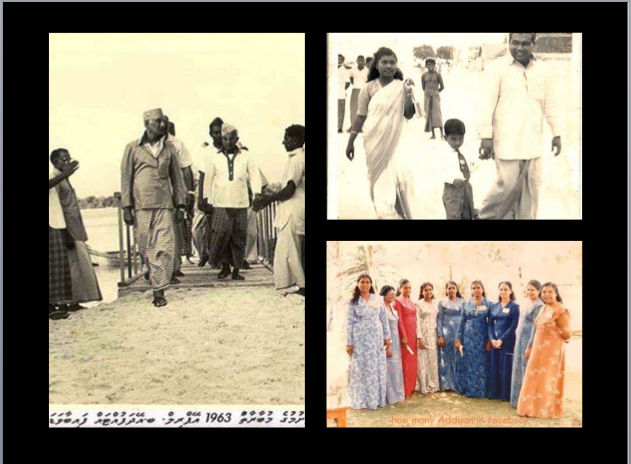
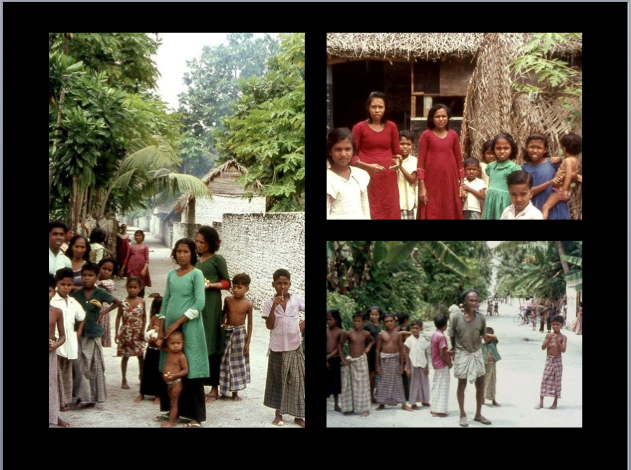
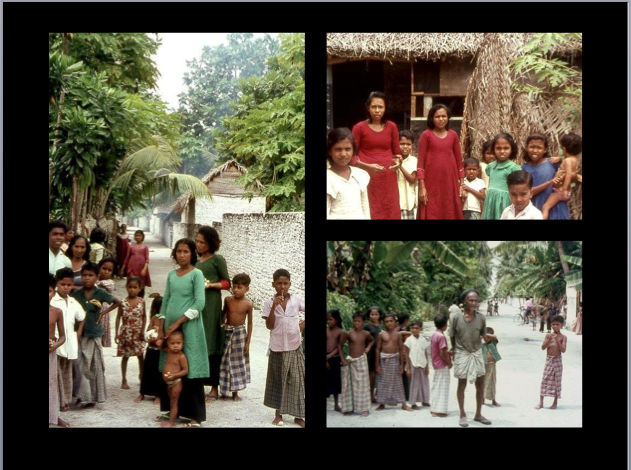
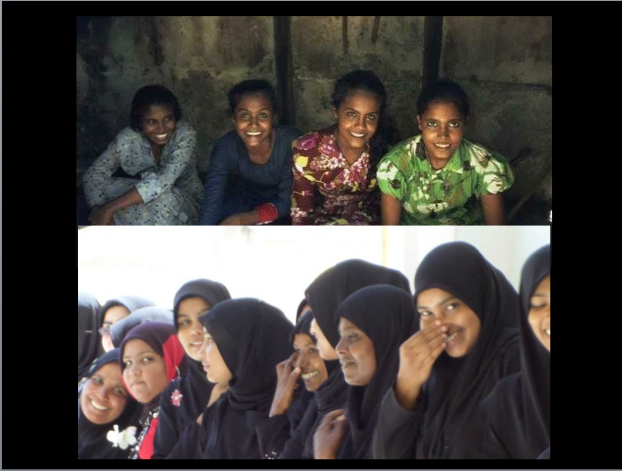
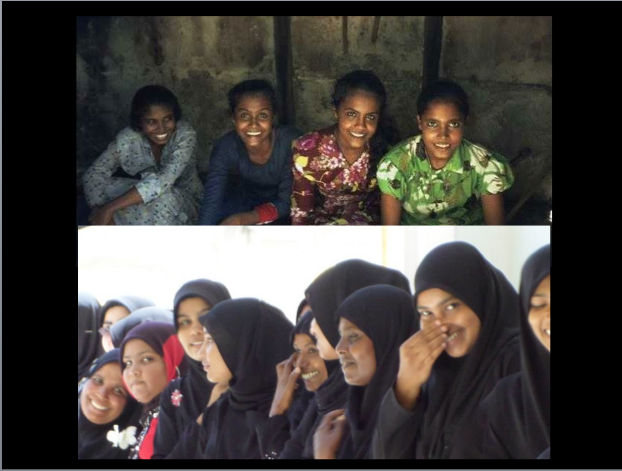
This revolutionary change occurred in almost total silence because the only voice allowed to speak on the subject were that of different types of Islamists whose only interpretation of what Islam says about the headscarf is that it is an absolute must for a Muslim woman. People who said otherwise were punished, and ostracised. They were given the label of un-Islamic. The increasing hegemony of Salafist/Wahhabist ideologies over Maldivian religious and social cultures and thought, and its control of religious discourse, forbid Maldives from speaking of not just another religion but also to pick up on any other strand of thought in Islam other than their own. Sufism, which is so much a part of South Asian Islam—and however much we may deny it, underpins many cultural and socio-religious practises in traditional Maldivian Islam—is discouraged in the Maldives if not outright outlawed. The Maldivian constitution says every Maldivian is a Muslim. And nothing can be said or done in the country that ‘contradicts Islam’. Wahhabi and Salafi missionaries have used the clause to market and spread—both online and offline—their ideologies as the ‘true Islam’. If this is the case, criticising and disagreeing with their ideologies is disagreeing with Islam.
I told participants about the most recent developments in this chapter of Maldives Islam with Saudi Arabia in which the two countries signed an agreement for ‘religious unity’. I drew attention to the openly expressed desire of Saudi Arabia to take Maldives under its wings, and remake the country in its own image. I showed them the following quote by Maldives Minister of Islamic affairs in signing the agreement:
“Unlike other countries, there are several challenges in the Maldives. A lot of Maldivians may not be aware of this, but there is an organised effort to sustain Western influences here. Those in power in Saudi Arabia understood that it will not do to leave Maldives like this.
“There are examples in the past of terrible consequences of the neglect of small nations like ours.”
To me, and to thousands of Maldivians who are refusing to accept Saudi dogma as Maldives culture by default, these are worrying statements that should raise danger signals.
I told them about the lost customs and punishments being revived as our own true culture: increasing Female Genital Mutilation (FGM), which had decreased to the point of non-existence; ending of the moratorium on death penalty which had lasted over half a century; the sentence (later revoked) by an island magistrate to stone a woman for fornication for the first time in known history of the Maldives; the increasing instances of children—especially girls—being deprived of school education; increase in number of people wanting to avoid vaccinating their children for religious reasons; and the increasing pressure—subtle and overt—on women to be less active and less visible members of society…these are all dramatic societal changes occurring in the Maldives of today.
Face to face with official policy: denial
The Dean of Maldives National University, Dr Abdul Rasheed Ali, or Absy in common parlance, was present at the conference. His sole purpose there appeared to be to deny any of these changes are occurring in the Maldives. Absy said I was generalising where I could not.
“I lost my bag yesterday. This does not mean everyone else have lost their bags,” this was Absy’s opening line in the five minutes he had been given to share his thoughts on forging a shared South Asian identity:
“I want to say what my colleague Azra said is not correct.”
Then he went on to tell this story, which baffled everyone.
“I was told to apply for a conference visa. I applied at the Indian High Commission in the Maldives. They called me and asked me to call on the Ambassador. When I did, the High Commissioner showed me the conference programme. He pointed to the title of Azra’s presentation.”
“This cannot be right,” the Indian High Commissioner said, according to Absy.
He was instructed to rebut, although at this stage, what would be said at the conference was only an idea in my head. I had not yet written the paper. Absy was ready to deny whatever it was I said.
“My daughter does not wear the headscarf. My wife does. It is in the Qur’an that every woman must wear the headscarf…”
At this point the Chair of the Panel cut Absy short, reminding him the topic under discussion was South Asia’s common future forward. He returned to the topic, but when asked to wind it down, became petulant.
“Why did you not ask other participants to make their presentation shorter? Why can’t I have the full number of minutes I was allocated? Why??”
Later he approached one of the presenters and told them, “Things are not like Azra says they are. She is saying that because she is from The Other Party, MDP.”
Absy’s story was quite shocking for everyone. Why would the Indian High Commissioner ask the Dean to rebut an academic discussion? Why would India want to ‘correct’ a paper on Saudi influence in the Maldives? How can something be corrected before knowing what it says? Would a High Commissioner have made such a move? None of the diplomats at the conference I spoke to were of the opinion a diplomat would be so undiplomatic.
Absy’s thinking, and his behaviour, are in line with official Maldives policy and stand in relation to changing religious practices in the Maldives: denial.
Time given for the talk was short; I had to leave out the more radical and dangerous behaviours in Maldivian culture that have resulted from widespread Revolutionary Islamism: Maldivian fighters leaving for Syria and Iraq. More per capita fighters from the Maldives have joined the ‘Jihadists’ than any other country in the world. More Maldivian Jihadists are in Syria and Iraq than from any other individual South Asian country. Maldivians are leaving the country as individuals, in groups, and as families spanning different generations. A Maldivian baby has been born in Syria. The current policy continues to be to deny Jihadists exist—a few bad apples, of course, yes. Not generalisable.
“It does not mean everyone else have lost their bags.”
The Counter-terrorism Act, passed amidst many criticisms, has not yet been used to prevent anyone from departing to join foreign wars. It has, however, been used quite liberally to criminalise and punish political opposition. Former President Mohamed Nasheed has been found guilty of terrorism and is being punished with a 13 year sentence. Former Defence Minister as well as current Vice President Ahmed Adeeb are also being kept in prison on terrorism related charges. This week, opposition MDP’s prominent member, Anwar Ibrahim, has been jailed for organising anti-government protests. He, too, is charged with terrorism. Meanwhile, those who are leaving to join groups to commit terrorising acts of gross-violence on fellow human beings, are free to leave. And operating just as freely are many actively engaged in convincing Maldivians that violence towards the achievement of a particular religious cause—defined in almost all known literature, and Maldives’ own law, as terrorism—is a religious duty.
Controlling thought and narrative
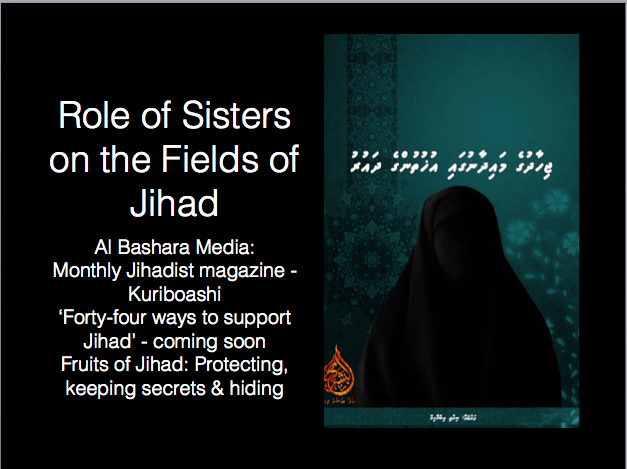
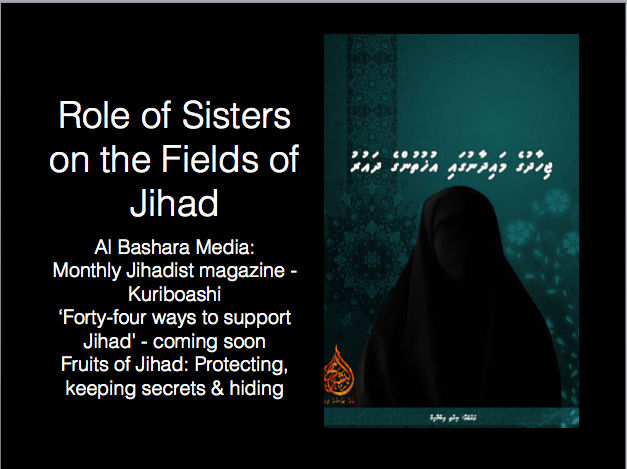
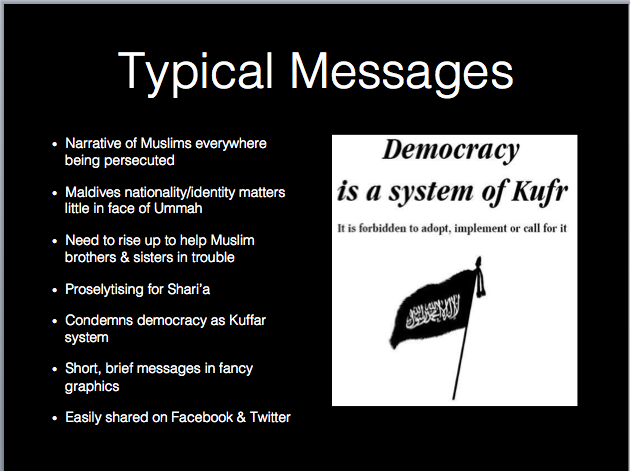
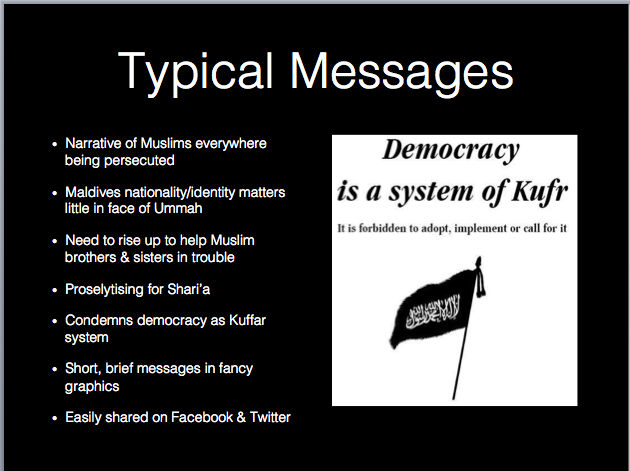
The narrative of Maldives has been under official control for decades, even centuries. The country’s Buddhist past, the account of how it became a country of ‘100% Muslims’, and now, how it is being changed into an emirate of an envisioned Saudi ‘caliphate’—these are all narratives under official control. Only certain people, saying certain things, belonging to a particular Madhab, of a particular form of religious learning, are allowed to—and accepted as speaking—‘the truth’ about Maldives. Those who see things differently to the official line are troublemakers, disobedient, uncouth, rabble-rousers, destroyers of public order—all terrorists. Their experiences of the Maldives are deemed invalid, and false. Not only are they excluded from official talk, they are also excluded from the realm of the rational. The real Maldives is what the government says it is.
This narrative is controlled from within by attempting to discredit voices opposed to the government by jailing them, or rejecting their opinions and thoughts as invalid, not in conformity with the vision it has for the Maldives, or as nonsensical. The same applies to scholars who take a different view from those who propagate Wahhabi and Salafi interpretations of Islam. Until recently, a large proportion of lecturers the government has invited have been revolutionary Islamists and ‘radical’ preachers who propagate their views. Surprisingly, last month saw Tariq Ramadan as an invited guest of the government. He may have been a guest with whom the dictators of the narrative were careful to pose for pictures, but Ramadan’s views are not being treated with such welcome. They went in one ear and out the other. The Maldives is pushing eagerly ahead with the death penalty, for just one thing. In the meantime, hundreds of Saudis were over to discuss the way forward for the Maldives Islamic University, only too happy and ready to begin shaping the thinking minds of Maldives’ future. When the mission is accomplished, there would be no contrary thought left for the expression of which people are willing to face the wrath of authorities.
The official narrative is carefully packaged and delivered not just domestically but to the rest of the world, too. The government thinks the telling of this narrative so important, it has spent millions hiring not one or two but three foreign PR firms to paddle their wares globally. Thus, empirical evidence not withstanding, the government continues to deny not just the spread of revolutionary Islamist thought and practices in the Maldives but also any existence of revolutionary Islamism.
“There is no ‘extremism’ in the Maldives”.
Never-mind the statistics mentioned earlier about Maldivian ‘Jihadists’. The narrative ignores not just the number of foreign fighters, but the existence of online and offline networks that exist solely for the purpose of persuading Maldivians ‘true Islam’ can only arise from revolutionary Islamism. This wilful ignorance of the phenomenon also provides the space in which Wahhabi and Salafi missionaries, as well as Jihadist recruiters, can work with total freedom from state interference. The denial is also covering up the fact that the government has sanctioned these changes—broadly affected through Saudi funding—that have deeply changed not just Maldivian Islam but its very identity. The fact of the matter seems to be the Maldives government does not really care about the Saudi-funded changes in Maldivian Islam; what matters is Saudi money.
What would a Maldives where Saudi ambitions for it have been successfully realised look like? Rest of South Asia comprises of countries speaking a thousand different languages, worshipping deities who exist in even higher numbers, and co-exist in a wide range of traditions and cultures. The Maldives people speaks one language, has one religion, and belongs to one ethnicity. Without the opportunity to access and be exposed to other cultures, it is easier to impose a homogenous culture on Maldivians from the above. An Islamic state re-made in the Saudi model in the SAARC is not something its leaders—and people—want to see. Encouraging more knowledge about each other may be a way forward in preventing the Maldives from becoming a Saudi Arabian religious colony in the not too distant future.
As I asked the conference—what role will such a Maldives play in a South Asia that wants to form a rich and diverse identity united by democratic, pluralist and tolerant cultures?
———————————
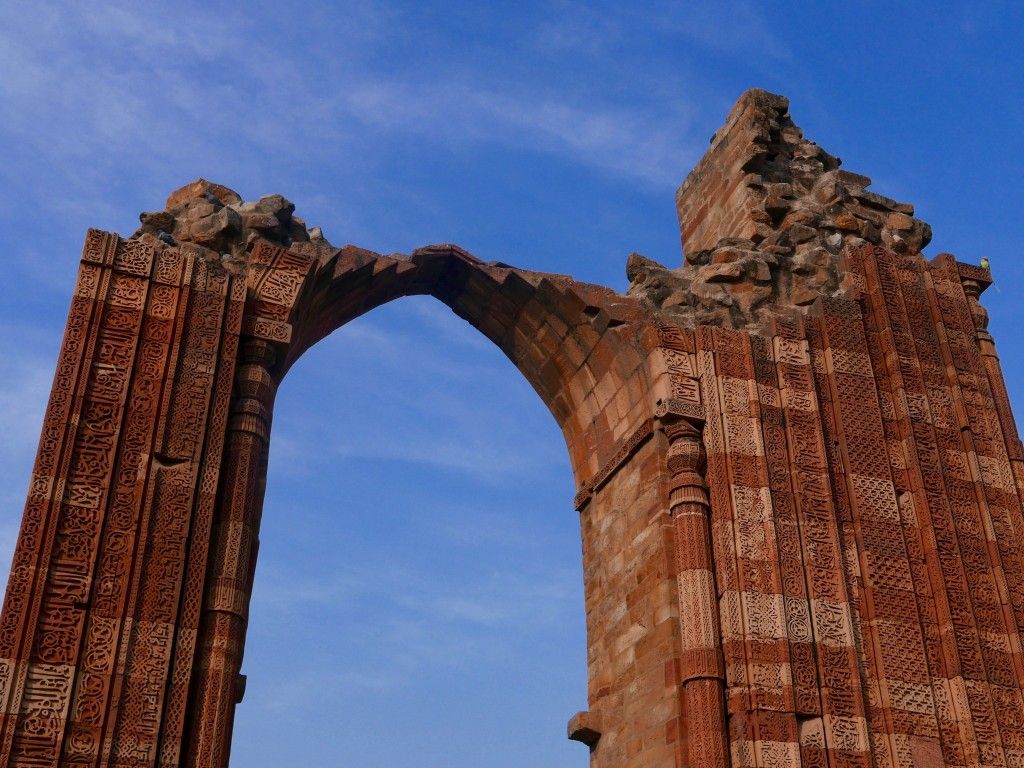
Photos: Main photo, ruins around the majestic Qutb Minar in New Delhi
All pictures in the first set of slides, except the last one in the last slide, are taken from Images of Maldives Past a valuable public repository of Maldivian culture on Facebook.
This article was originally published on Dhivehisitee.com. It has been republished with permission.
All comment pieces are the sole view of the author and do not reflect the editorial policy of The Maldives Independent. If you would like to write an opinion piece, please send proposals to [email protected]
Discussion
No comments yet. Be the first to share your thoughts!
No comments yet. Be the first to join the conversation!
Join the Conversation
Sign in to share your thoughts under an alias and take part in the discussion. Independent journalism thrives on open, respectful debate — your voice matters.
Support Independent Journalism
Help us keep the news free and fearless
Give once
$
or
Become a memberfrom $5/month