
Three months in: What’s next for the Maldives Independent?
We’re thrilled you’re reading us. Three months after relaunch, we look at how far we’ve come, where we’re going, and why membership plans, Dhivehi content, and (yes) comments matter for building a truly independent Maldives Independent.
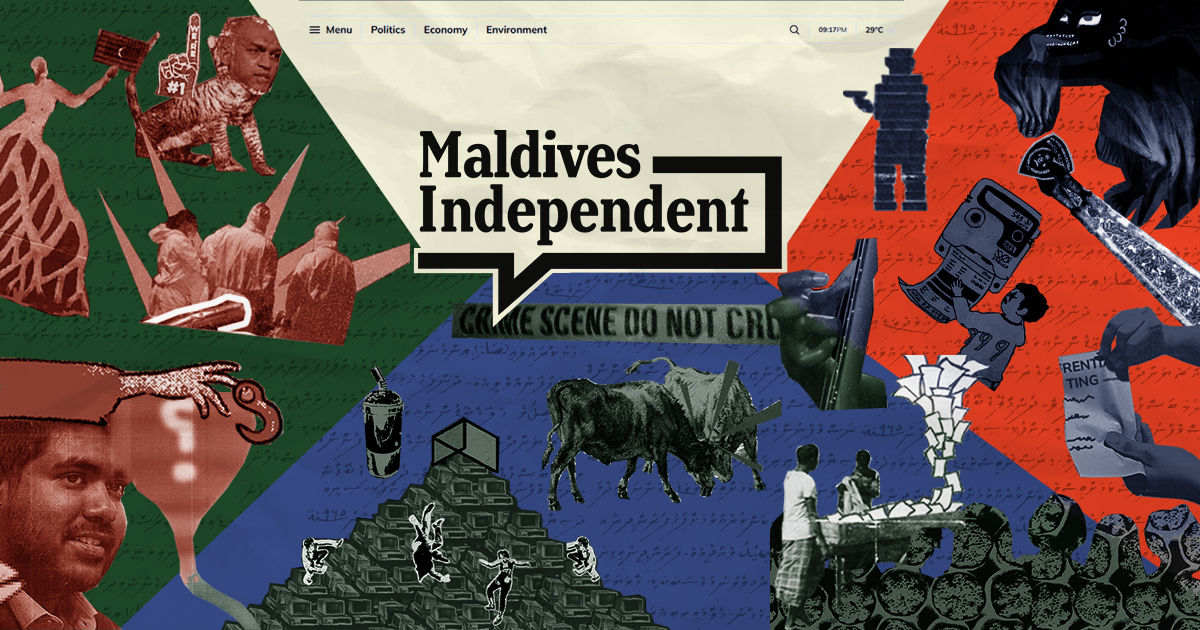
Artwork: Dosain
17 May 2025, 12:12
It’s been three months since the relaunch of the Maldives Independent, five years after it closed down due to a decline in advertising revenue. We’re delighted (not to mention relieved) at the positive reception, support and enthusiasm we’ve received for its return. We wanted to share some of those numbers, as well some future plans.
The plan from the start was to focus on features and analysis, bringing depth and context to the daily news grind rather than chasing every (15 hour) press conference and political utterance with our very limited resources.
Some stories have taken on a life of their own, as in the case of Hawwa Yumn Rasheed’s fall from a nine-storey building in unexplained circumstances. Here the team has taken time to verify information leaked online, as well as covering Yumn herself, the weeks of demonstrations by young people protesting against impunity, nepotism and police negligence, and the crackdown launched in response. With breaking stories like this week’s dismissal of two Supreme Court justices, we’ve compiled months of events into timelines showing all the behind-the-scenes manoeuvring.
We’ve also revisited stories we missed during our five years in the wilderness, following up on failures of justice in the murder of blogger Yameen Rasheed, and the attempted assassination of former President Mohamed Nasheed. Naish, editor-in-chief and not one to hold a grudge, went so far as to list every single story we missed in those five years (an undertaking of 70 pages). My favourite recent piece is probably Hassan’s investigation of something every diver and snorkeller seems to bring up: just why are there so many sharks? Speaking to dozens of marine biologists, fishermen, conservationists and dive instructors, he spotlights the practice of ‘chumming’ and uncovers the real underwater villains of the Maldives: fish-bothering Instagram influencers.
The numbers
Since relaunching in February the Maldives Independent has reached an active userbase of 56,000 people, who have collectively visited more than 315,000 articles. Our newsletter, a weekly roundup with a sprinkling of newsroom gossip, has an open rate that hovers around 80 percent, compared to an industry average of 12.4 percent. We’ve also reached more than a million views on Instagram, in large part due to readers sharing our stories with others.
While the Maldives Independent is a reboot with much of the same team as 2020, it’s still also a media startup in a climate of severe uncertainty around the future of journalism. These are encouraging early figures that give us confidence in the outlet’s future.
It’s also clear that the audience of the Maldives Independent is hardly a passive readership, but an active distributor and participant in our work. Some of the most popular articles we’ve published have been those written by contributors, like Shahudha Mohamed’s piece on the judicial acknowledgement of battered women’s syndrome in the Mariyam Nazaha case (reaching a quarter of a million on Instagram). Opening the newsroom to a wide range of (paid!) contributors was one of the best decisions we made. If you’d like to pitch a piece, please get in touch.
Next steps: Membership, Dhivehi, comments
We’re hard at work now on the second phase of the new website, due in September. The most important new feature will be a membership program allowing readers to support the Maldives Independent directly, with a monthly contribution. This isn’t a paywall - we think it’s important that MI remains open and accessible to all, regardless of means. Most importantly, becoming a member of MI will help guarantee its independence and ensure it stays accountable to its most important audience: you.
That said, we don’t expect members to survive just on profuse gratitude. There’ll be a dedicated newsletter, a behind-the-scenes view of the newsroom, event invitations, possibly merch - there’s been talk of a tote bag…
A reality of journalism is that all sources of media funding come with some level of compromise. Political support is common in the Maldives and obviously one of the worst, but advertising too can leave a newsroom beholden to corporate and state interests - particularly when stories come up relating to those interests. We have some hopes for international development support - but that’s lately collapsed to a trickle and often overlooks the Maldives anyway - despite it being the 31st largest country in the world in terms of territory.
Moreover, if there’s a universal truth to international media philanthropy, it’s that it will fund anything - workshops, training, drones, absolutely anything - other than actual journalism, while burying you in mountains of impact assessments and report writing. An NGO, on the other hand, might receive vast sums from international funders to promote accountability and good governance, then measure its impact through the number of press releases it manages to get published by an impoverished media ecosystem captured by politicians and oligarchs.
So, if you’re reading this, we think you (and a highly diversified revenue stream) are the Maldives Independent’s best chance of survival this time around. No pressure.
Comments
A happy coincidence of soliciting login details will be the return of the comments section, much-loved during former iterations of the Maldives Independent. We’re hoping it will again become a forum for wholesome civic debate, and ideally result in fewer police raids than it did last time. You’ll be able to view the site without logging it, and we’ll offer a secure alias to those who do log in and wish to comment. Members who comment will also have the option of enabling acknowledgment of their support.
Weekly Dhivehi edition
Our early market research observed that many younger Maldivians in particular prefer written English (despite readily speaking Dhivehi), so this was our focus at launch. Ithuru Vaahaka, the Maldives Independent’s new weekly podcast, will be Dhivehi first, while the site upgrade will include provision for Dhivehi articles, a weekly Dhivehi edition featuring our top stories, and depending on the developer’s level of sleep deprivation, automatic translation. We’ve also planned a range of accessibility features to make the site more accommodating (initial tests with Braille were less than successful).
Conclusion
The press climate in the Maldives in 2025 is very different to that of the 2009-2013 period when I was editor of MI’s precursor, Minivan News. The Minivan News website was operationally independent, passed from one editor to another like a hot potato. But for many Maldivians the Minivan brand remained associated with the MDP, due to the party's defunct Minivan Daily and Minivan Radio. These were among the first non-state controlled media to emerge in the Maldives, and played an important part during the 2003 democracy movement.
After the introduction of multi-party democracy in 2008, Minivan News had to vigorously assert its independence in a heavily polarised society. The former regime, hardly paragons of press freedom (or at least, free press that was critical), distrusted it. On the other hand, many members of the MDP saw its efforts to hold the new government to account as inherently traitorous. At the time we trusted that the proof was in the pudding, the content spoke for itself, and left readers to make up their own minds. Minivan’s success was ultimately measured in how starved it was for funding, and in how few friends it had.
The Maldives has changed. Partisan politics is heavily distrusted and political cynicism is at an all time high. This time the Maldives Independent needs more friends and supporters, not fewer. I hope you will become a part of this community, take a stake in its success, and support the cause of Maldivian journalism that stands up for justice, truth and accountability.
JJ Robinson is advisor to the Maldives Independent and a former editor. He is the author of Maldives: Islamic Republic, Tropical Autocracy, and has a professional background in media development.
Discussion
No comments yet. Be the first to share your thoughts!
No comments yet. Be the first to join the conversation!
Join the Conversation
Sign in to share your thoughts under an alias and take part in the discussion. Independent journalism thrives on open, respectful debate — your voice matters.
Support Independent Journalism
Help us keep the news free and fearless
Give once
$
or
Become a memberfrom $5/month